Showing posts with label Adventure. Show all posts

Tuesday, July 3, 2018

CFP Indiana Jones and the Edited Collection of Critical Essays (9/1/2018)

A great idea for a collection:

Indiana Jones and the Edited Collection of Critical Essays
https://call-for-papers.sas.upenn.edu/cfp/2018/05/20/indiana-jones-and-the-edited-collection-of-critical-essays

deadline for submissions: September 1, 2018

full name / name of organization: Randy Laist / McFarland

contact email: rlaist@goodwin.edu


With his signature bullwhip and fedora, the familiar sounds of his orchestral anthem, and his eventful explorations into the arcana of world religions, Indiana Jones – archeologist, adventurer, and ophidiophobe – has become one of the most recognizable heroes of the silver screen. Since his debut in 1981’s Raiders of the Lost Ark, Indiana Jones has appeared in three sequels, and Steven Spielberg has recently announced that he will soon begin production on a fifth Indiana Jones film. Along the way, the character has spawned a raft of children’s novels, cartoon and live-action television series, and video and role-playing games. Despite the longevity and popularity of the Indiana Jones franchise, however, it has rarely been the focus of academic criticism, a fact which is surprising considering the critical attention enjoyed by other early George Lucas and Steven Spielberg films. As stories about archeology, the Indiana Jones tales reflect an array of ethical questions and representational issues regarding the nature of the past. As stories about an American man globe-trotting in the middle of the twentieth century, Indiana Jones’s adventures intersect with a wide range of cultural narratives about World War II, the late colonial era, and late-century nostalgia for perceived mid-century ideals. As stories about the sacred, Indiana Jones’s quests engage questions about the nature of the sublime, the representation of the otherworldly, and the role of narrative in constructing reality.

McFarland is interested in publishing a multiauthor volume about the Indiana Jones franchise. While the study will approach the subject from a wide range of perspectives, the book will be centered around the theme of the quest. Indiana Jones narratives are propelled by the pursuit of what Hitchcock called the MacGuffin and what Lacan called objet petit a, and they dramatize and comment upon the nature of loss, desire, and ambiguous retrieval, as well as upon the dynamics of acquisitiveness, appropriation, and possession. Indiana Jones’s reclamation of sacred objects illustrates cultural attitudes about how the past is remembered and preserved (or not), how historical truth is defined and organized, and how socio-political power becomes invested in physical artifacts. At the same time, Indiana Jones films are themselves historical artifacts, glowing with the same shimmering aura of signification that Spielberg’s camera imparts to Indy’s quarries. The theme of the quest, therefore, unites the analysis of individual Indiana Jones texts with the wider analysis of Indiana Jones as a cultural reference point.

Chapter topics may include, but are by no means limited to, such subjects as:

  • Representations of: archeology, Nazism, the sacred, the past, colonialism, non-Western cultures, mid-century America, World War II, heroism, paternity, globalization, geography, etc.
  • Indiana Jones and cinematic pastiche: the inheritance of Gunga Din (1929), King Solomon's Mines (1950), The Secret of the Incas (1954), film noir, etc.
  • The relationship between the Indiana Jones films and Spielberg’s other films
  • Indiana Jones and the “hard body” action hero of the 1980s
  • The extended franchise: children’s novels, Choose Your Own Adventure books, role-playing games, video games, “The Young Indiana Jones,” etc.
  • Representations of women: plucky sidekicks, damsels in distress, femmes fatales
  • Fan culture, from the Gen-X nostalgia of Raiders! The Story of the Greatest Fan Film Ever Made (2015) to the hostile reception of Indiana Jones and the Kingdom of the Crystal Skull (2008)
  • Narratology of the artifact: the MacGuffin, le petit object a, the Holy Grail, etc.
  • Cultural appropriation and the controversial legacy of Hiram Bingham
  • Indiana’s fear of snakes and the theme of threatening encounters with different animal species throughout the series

Please send 300-word abstracts to Randy Laist at rlaist@goodwin.edu by September 1, 2018, or feel free to contact me with queries at any time.

Tuesday, August 6, 2013

Primeval: New World TV Marathon

Syfy will air a marathon of its "new" series Primeval: New World this Saturday, 10 August. The series is actually a Canadian-made production based on the popular ITV series Primeval, which aired in the US on BBC America. The latest version lasted for 13 episodes before its cancellation (and subsequent airing on Syfy). The Region 1 DVD/Blu-ray release of the series occurs this fall; the series is already available through video on demand services.


Marathon Schedule:

10:00 AM Primeval: New World - The New World
11:00 AM Primeval: New World - Sisiutl
12:00 PM Primeval: New World  - Fear Of Flying
01:00 PM Primeval: New World  - Angry Birds
02:00 PM Primeval: New World  - Undone
03:00 PM Primeval: New World  - Clean Up On Aisle 3
04:00 PM Primeval: New World  - Babes In The Woods
05:00 PM Primeval: New World  - Truth
06:00 PM Primeval: New World  - Breakthrough
07:00 PM Primeval: New World  - The Great Escape
08:00 PM Primeval: New World  - The Inquisition
09:00 PM Primeval: New World  - The Sounds Of Thunder - Part 1
10:00 PM Primeval: New World  - The Sounds Of Thunder - Part 2


Thursday, March 21, 2013

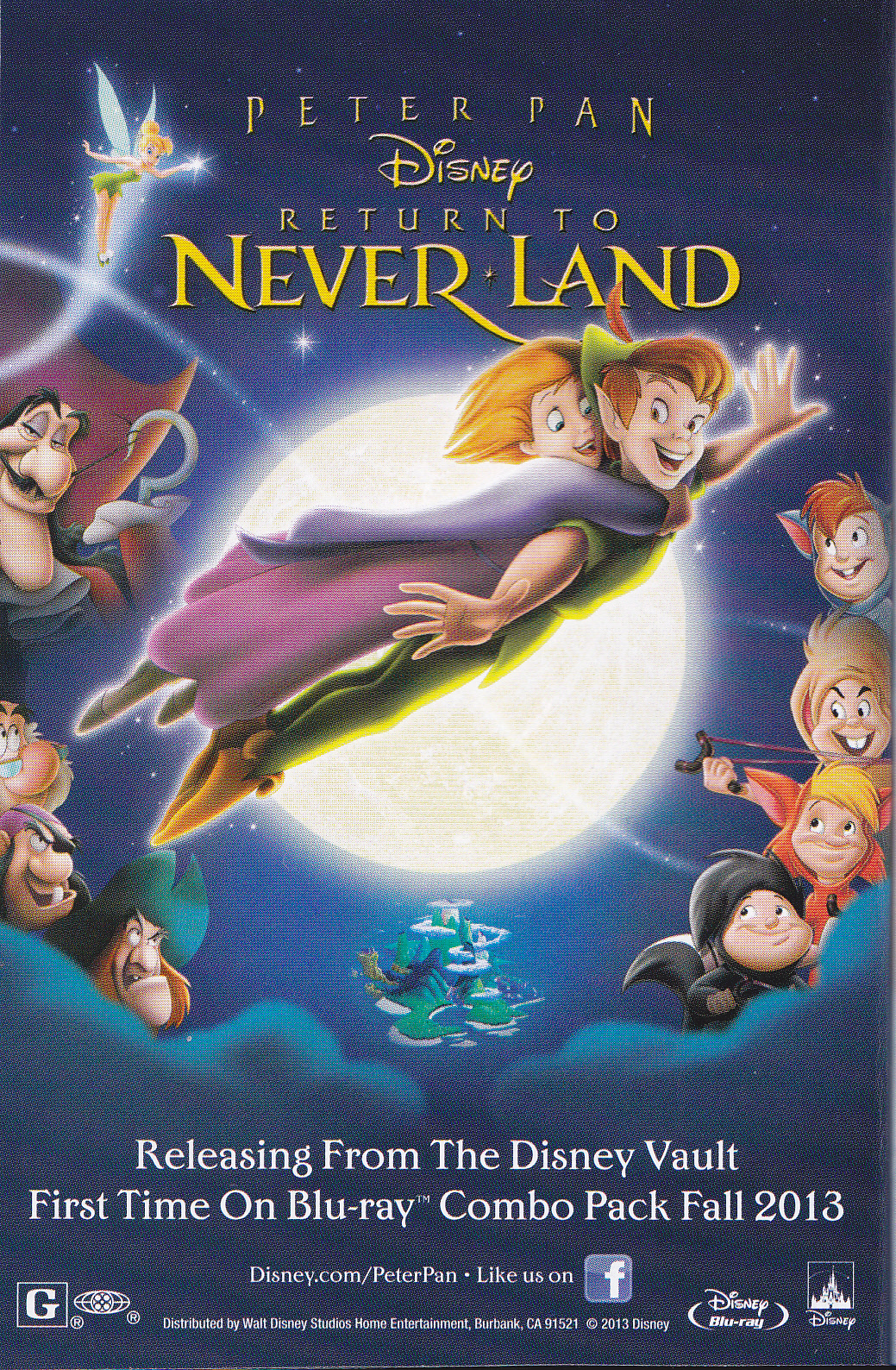
Return to Neverland News

An upcoming release revealed (appropriately) in the packaging for Peter Pan Diamond Edition:


Tuesday, November 20, 2012

Little Mermaid News

Disney has released the following advertisement for an upcoming release of The Little Mermaid (1989), the film that ushered in the Disney Renaissance:


Peter Pan Diamond Edition

Disney has announced as February 2013 release of a new edition of the classic film Peter Pan. It will be available to own on Blu-ray. No word yet on the extras, but the following trailer is now featured on Disney's various websites:

Monday, November 19, 2012

The Croods?

Here's another upcoming film:


Monday, April 16, 2012

Sherlock Returns

The hit BBC series Sherlock, a modern-day updating of the Sherlock Holmes story, returns to PBS next month and, also, to DVD. Details at http://www.pbs.org/wgbh/masterpiece/sherlock/.

Wednesday, February 22, 2012

Wired on John Carter

Wired (in both its print and web incarnations) features a look this month at the upcoming John Carter film. Take a look at  http://www.wired.com/magazine/2012/02/ff_johncarter/all/1.


Sunday, December 11, 2011

New Trailers from Warner Bros. Pictures

Coming Soon:

Monday, July 18, 2011

CFP Approaches to Adventure in the Late 19th Century (8/1/11) (NeMLA)

http://call-for-papers.sas.upenn.edu/node/41644

NEMLA: March 15-18, 2012. Call for papers – Approaches to Adventure in the Late 19th Century
full name / name of organization:
Rebekah Greene/University of Rhode Island
contact email:
Rebekah_greene@my.uri.edu

This panel examines the burgeoning interest in adventure during the years 1880-1901. Joseph A. Kestner in his recent _Masculinities in British Adventure Fiction, 1880-1915_ has suggested that adventure texts are filled with ‘codes’ such as ‘rescue, heroism, survival, courage, duty, isolation, voyaging’ for audiences to ‘live up to’ (1). Papers that scrutinize late Victorian literary treatments of these codes, in addition to tropes such as travel, sailing, mountain climbing, and camping are warmly welcomed.

Possible questions to examine include:
What is the cultural or historical significance of this attention to adventure and why should it be celebrated?
Why are the codes of adventure important, for both the individual and for the state?
How do Victorian authors of adventure texts use their works to problematize empire?
Can adventure texts function as pedagogical tools for younger readers, colonial administrators, or emigrants?
Do adventure texts function at different levels for colonizing or colonized audiences?
How do female authors treat the codes of adventure?
What does this intense engagement with adventure reveal?

Please submit 250-500 word abstracts (as an MS Word attachment, please) to Rebekah Greene, rebekah_greene@my.uri.edu, with NEMLA 2012 as the subject heading by August 1st, 2011.

Information for the convention can be found at http://www.nemla.org/convention/2012/