Showing posts with label Disney. Show all posts

Sunday, August 24, 2025

CFP Disney: A Companion (1/1/2026)

Disney: A Companion


deadline for submissions:
January 1, 2026

full name / name of organization:
Lorna Piatti-farnell and Simon Bacon

contact email:
lpfarnell@gmail.com

source: https://call-for-papers.sas.upenn.edu/cfp/2025/07/26/disney-a-companion


The editors invite abstracts for a forthcoming edited volume entitled Disney: A Companion, which will offer a comprehensive critical exploration of The Walt Disney Company’s cultural, historical, aesthetic, political, and industrial significance. The Companion is intended for the Peter Lang Genre Fiction and Film Companion series (https://www.peterlang.com/series/gffc), and aims to bring together a wide range of interdisciplinary perspectives that interrogate Disney’s enduring legacy and its evolving role in global media and culture.


Since its founding in the 1920s, The Walt Disney Company has shaped not only the animation industry but also broader cultural discourses around childhood, storytelling, consumerism, technology, representation, and national identity. Disney’s innovations in animation – from the early days of Steamboat Willie and Snow White and the Seven Dwarfs, to the more recent digital revolutions seen in Frozen and Encanto – have established it as a central player in the development of visual culture. However, Disney’s influence and reach extend well beyond animation, and its characteristic fairy-tale narrative set ups. They encompass live-action films of different genres, television, comics, theme parks, corporate acquisitions and partnerships (including Pixar, Marvel, Lucasfilm, and 20th Century Studios), streaming platforms, and merchandising. Disney has not only contributed to the development of the animated film as we know it, but also arguably shaped how generations of audiences have experience transmedia storytelling on a wider scale. All of these aspects of the ‘Disney phenomenon’ form a complex conglomerate deserving of sustained scholarly attention across disciplines and contexts.


Taking this as a point of departure, this Companion seeks to engage with Disney not merely as a brand or an entertainment company, but as a key site for creative, cultural, social, historical, political, and industrial negotiations.


Topics might include, but are not limited to:

  • Aesthetics and Technologies: techniques and styles in traditional, digital, and hybrid animation; evolution of character design and character identities; Disney’s visual storytelling strategies; evolving digital technologies; collaboration with and influence on other studios; audio-visual and industrial considerations, including the use of music and songs; critical approaches to the aesthetic, industrial, and cultural category of the ‘Disney film’.
  • Franchises, Adaptations, and Transmedia Storytelling: convergence culture and the evolution of serial storytelling within the Disney empire, including Disney+ and the Disney Channel; case studies on the Marvel Cinematic Universe, Star Wars, and beyond, through a Disney lens; transnational reimaginings; paratextual materials, fan practices, remix culture, and counter-discourses surrounding Disney texts.
  • The Body and Embodiment: how bodies are animated, idealized, and regulated in Disney media; discourses of beauty, physical transformation, and anthropomorphism; disability, and the relationship between the body and mental health in Disney narratives; body transformations and the construction of the self.
  • Representations of ‘Good and Evil’: ethical boundaries and moral binaries within the Disney multiverse; constructions of heroes and villains, and the virtues/values associated with them; politicised understandings of purpose and goals; magic and witchcraft as central Disney tropes; monsters and the monstrous.
  • Race, Ethnicity, and Representation: critical approaches to racial and ethnic portrayals in Disney films and television; Indigeneity and complex representations of ‘Otherness’ within Disney properties.
  • Gender and Sexuality: changing depictions of femininity and masculinity; Feminist critique and queer readings of Disney narratives; gender performativity in animation and live-action; representation in the Disney Princess franchises and beyond; LGBTQI+ representation in both Disney texts and Disney fan communities.
  • Ecology and the Environment: environmental critique within Disney films; corporate practices and environmental considerations; Disney parks and environmental discourses.
  • Historical Perspectives: Disney's role in the development of the American film industry; propaganda and nationalism in wartime productions; corporate history and its intersections with broader historical events.
  • Consumerism, Childhood, Nostalgia, and Fandom: the commodification of childhood and family entertainment; Disney’s influence on children’s culture and education; nostalgia and intergenerational fandom; critical explorations of ‘Disney adult’ fan communities; Disney cosplay and fan-narratives (including fan-vids, fan-fiction, and beyond); Disney and pedagogical discourses.
  • Merchandise, Toys, and Marketing: audience-specific merchandise lines, including critical considerations of ‘Disney Princesses’ products and properties; rare items, collectibles, and exclusivity; branding and marketing strategies in diverse international contexts; Disney parks and the consumer experience.
  • Creativity, the Cultural Industries, and Globalization: Disney’s global reach, including localized content and international reception; considerations over creativity and intellectual property; the cultural impact of Disney properties as creative channels; Disney properties, including theme parks, as cultural institutions in the transnational landscape.


The editors invite abstracts of 250-300 words on or around any of the above topics. Final essays will be 3,000 words in length.

The deadline for submission of abstracts is 1st January 2026. Please email your abstracts (together with a short bio, 150 words max) for consideration to both editors: Lorna Piatti-Farnell, lorna.piatti-farnell@sae.ac.nz; and Simon Bacon, baconetti@googlemail.com.


Last updated July 28, 2025

CFP Edited Volume on Star Wars and Politics in the Disney Era (9/30/2025)

CFP: Edited Volume on Star Wars and Politics in the Disney Era


deadline for submissions:
September 30, 2025

full name / name of organization:
Dominic J Nardi

contact email:
dnardi@umich.edu

source: https://call-for-papers.sas.upenn.edu/cfp/2025/07/28/cfp-edited-volume-on-star-wars-and-politics-in-the-disney-era


This edited volume seeks to collect scholarship on the treatment of political themes and world-building in the Star Wars franchise since Disney acquired Lucasfilm in 2012. Scholars have thoroughly explored political topics in George Lucas’s works, but have paid less attention to how Star Wars projects under Disney have continued, changed, or challenged the franchise’s approach to politics. To advance the scholarship on this subject, we welcome proposals from a variety of disciplines and perspectives, including literary criticism, cultural history, political science, film studies, and fandom studies.


Possible / Suggested Topics:

We are willing to consider relevant proposals about Star Wars stories in any medium — including films, TV shows, novels, comics, and video games — published since Lucasfilm reset the Star Wars canon in April 2014. Below are some topics that essays selected for the volume might address. Please consider this list a starting point for ideas rather than an exhaustive checklist of desired coverage. 
  • Everyday heroes and weapons of the weak in Rogue One and Andor
  • Political idealism in The High Republic multimedia project
  • Magical weapons to identify rightful rulers in Rebels, The Mandalorian, and The Book of Boba Fett
  • Luthen’s accelerationism in Andor
  • Links between the Empire and organized crime
  • Post-conflict justice in the Aftermath and Alphabet Squadron novels
  • Information warfare and propaganda, including the Star Wars Propaganda artbook
  • Political parties in Bloodlines as a commentary on American polarization
  • Star Wars Visions and Ronin as non-Western perspectives on politics in Star Wars
  • Mistreatment of veterans in Rebels, The Bad Batch, Andor, and Obi-Wan Kenobi
  • Transplanetary corporations and the military-industrial complex
  • Income inequality and the donor class in The Last Jedi
  • Pre-Mor Authority and the Empire’s use of contractors
  • Political dynasties and/or cults of personality
  • How political debates during the 2010s and early 2020s affected responses to the Sequel Trilogy
  • Interconnections between the State and carceral institutions
  • Tensions between political and religious institutions
  • Nemik’s manifesto as political rhetoric


Submission and Contact:

Interested authors should email the following to sweede01@luther.edu and dnardi@umich.edu by September 30, 2025:
  • 300-500 word abstract of your proposed chapter;
  • Contact information - name, email address, and any institutional affiliation;
  • Resume/CV for each author/co-author (in any format).

Selected authors will be notified by November 1, 2025, and will be invited to contribute a first draft of a full-length chapter by May 4, 2026. Essays should be between 5,000-7,500 words.


About the Editors

Derek Sweet (sweede01@luther.edu) has been a professor in the communication studies department since 2005, focusing on the topics of rhetoric and public address. Some of his course topics include Public Address, Advanced Public Address, Rhetoric of Everyday Life, Rhetoric of Spirituality, and Media & Popular Culture. He also coedited The Transmedia Franchise of Star Wars TV (Palgrave 2020) and wrote Star Wars in the Public Square (McFarland, 2015).

Dominic J. Nardi (dnardi@umich.edu) is a political scientist who researches the depiction of politics in science fiction and fantasy. He coedited and wrote chapters for The Transmedia Franchise of Star Wars TV (Palgrave 2020), Discovering Dune (McFarland 2022), and Studio Ghibli Animation as Adaptations (2025). He received his PhD from the University of Michigan and teaches at George Washington University.


Last updated July 28, 2025

Saturday, January 18, 2025

CFP The Magic Kingdom: Exploring Disney’s Impact on Popular Culture (6/30/2025; online 9/4-5-2025)


The Magic Kingdom: Exploring Disney’s Impact on Popular Culture

deadline for submissions: 
June 30, 2025
full name / name of organization: 
PopCRN - The Popular Culture Research Network

PopCRN (the Popular Culture Network) is back with a virtual conference exploring all things Disney, to be held online on Thursday 4th and Friday 5th of September 2025.

Since the Walt Disney was founded his eponymous film studio in 1923, the Disney brand has been a mainstay of popular entertainment. The iconic Micky and Minnie Mouse head the line-up of an impressive array of characters and actors that have become cultural icons. Today Disney is a conglomerate of entertainment businesses, investing in theme parks, sports television, a cruise line, resort destinations, National Geographic Expeditions, clothing, games, and publishing.

We welcome papers from researchers across the academic spectrum and encourage papers from postgraduate researchers and early career researchers. Presenters will be given the opportunity to submit their presentations as articles to a special edition of the International Journal of Disney Studies.

To whet your appetite, we have provided some topics below. We will also accept topics beyond this scope:

  • "Today is a good day to try" – Optimism in Disney.
  • "Some people are worth melting for" – Friendship in Disney.
  • "Can anybody be happy if they aren’t free?" – The philosophy of Disney.
  • "Remember who you are" – Identity and meaning in Disney.
  • "Ohana means family. Family means nobody gets left behind or forgotten” – The importance of family in Disney.
  • "When I look at you, I can feel it. And I, I look at you and…I'm home" – Domesticity in Disney
  • "Life's a little bit messy. We all make mistakes. No matter what type of animal you are, change starts with you" – Representations of animals in Disney
  • "If you're going hard enough left, you'll find yourself turning right" – Ideology in Disney
  • "Everything is possible. Even the impossible" – Disney’s technological breakthroughs.
  • "Whatever choice you make, let it come from your heart" – Love in the Disneyworld.
  • "Ladies do not start fights, but they can finish them" – Representations of gender in Disney.
  • "If you're going hard enough left, you'll find yourself turning right" – Disney and the political sphere.
  • "You're mad. Bonkers. Off your head. But I'll tell you a secret, all the best people are"- Disney and classical literature.
  • "The problem is not the problem. The problem is your attitude about the problem. Do you understand?" – Positivity in Disney.
  • "Can anybody be happy if they aren’t free?" – Philosophy and Disney
  • "Being young and beautiful is not a crime, you know" – The princess / evil stepmother dichotomy in Disney.
  • "A queen is never late. Everyone else is simply early" – Depictions of royalty in Disney
  • "All it takes is faith and trust" – Religion and Disney
  • "I don’t see how a world that makes such wonderful things could be bad" – The dark side of Disney.
  • "Everybody’s got problems. The world is full of problems” – Global politics and Disney.
  • “Why are you threatened by anyone different than you?" – Disney and diversity.
  • “In every job that must be done, there is an element of fun. Find the fun aaaaaaaand, snap! The job’s a game!” Representations of work and labour in Disney
  • “Just keep swimming…just keep swimming” – From cruises to hotels; Disney in the Leisuresphere.
  • “You’re never too old for a Disney Movies” – Disney Fandom
  • "Hakuna Matata" – The music of Disney
  • “To infinity, and beyond!” – The eternal success of Disney.

Please submit via our portal - https://unesurveys.au1.qualtrics.com/jfe/form/SV_8jjzaWnS732QsFE

  • Abstracts (200 words)
  • Biography (100 words)

To submit to the journal: https://unesurveys.au1.qualtrics.com/jfe/form/SV_1FBqwXuomrgKKx0

To register for the conference, Registration is free for everyone: https://unesurveys.au1.qualtrics.com/jfe/form/SV_7TGWUYZidtlxVLU

Queries to popcrn@une.edu.au

Saturday, September 24, 2022

Coming Soon from Disney: Strange Worlds

 Trailer for an upcoming Disney film. It looks like a version of Journey to the Center of the Earth.


Sunday, October 13, 2019

CFP Myth and Fairy Tales Area (10/31/2019; SWPACA 2/19-22/2020)

Call for Papers: Myth and Fairy Tales at Southwest Popular/American Culture Association (SWPACA) 2020
https://call-for-papers.sas.upenn.edu/cfp/2019/09/17/call-for-papers-myth-and-fairy-tales-at-southwest-popularamerican-culture-association


deadline for submissions: October 31, 2019

full name / name of organization: Southwest Popular/American Culture Association

contact email: sheila.dooley@utrgv.edu


Call for Papers

Myth and Fairy Tales

Southwest Popular / American Culture Association (SWPACA)


41st Annual Conference, February 19-22, 2020

Hyatt Regency Hotel & Conference Center

Albuquerque, New Mexico

http://www.southwestpca.org

Proposal submission deadline: October 31, 2019


Proposals for papers and panels are now being accepted for the 41st annual SWPACA conference.  One of the nation’s largest interdisciplinary academic conferences, SWPACA offers nearly 70 subject areas, each typically featuring multiple panels.  For a full list of subject areas, area descriptions, and Area Chairs, please visit http://southwestpca.org/conference/call-for-papers/


All scholars working in the areas of myth and/or fairy tales are invited to submit paper or panel proposals for the upcoming SWPACA Conference. Panels are now forming on topics related to all aspects of myths and fairy tales and their connections to popular culture. To participate in this area, you do not need to present on both myths and fairy tales; one or the other is perfectly fine. Presentations considering both genres are of course welcome and can stimulate interesting discussions. Proposals for forming your own Myth or Fairy Tale-focused panel – especially panels focused on one particular myth/tale – are encouraged.

Paper topics might include (but are certainly not limited to):


  • Where Fairy Tales and Myth Overlap
  • Non-Western Myths and Fairy Tales
  • Revised Fairy Tales
  • Fairy Tales in/as “Children’s Literature”
  • Disney
  • Urban Fairy Tales
  • Ethnic Myths and Fairy Tales
  • Gendered Readings of Myths and Fairy Tales
  • Postcolonial Myths and Fairy Tales
  • Myths and Fairy Tales in Advertising Culture
  • Reading Myths and Fairy Tales in the Popular Culture of Past Centuries
  • Performing Myths and Fairy Tales: Drama and/or Ritual
  • Genres of Myths and/or Fairy Tales: Film, Television, Poetry, Novels, Music, Comic Books, Picture Books, Short Stories, or Graphic Novels


All proposals must be submitted through the conference’s database at http://register.southwestpca.org/southwestpca


For details on using the submission database and on the application process in general, please see the Proposal Submission FAQs and Tips page at http://southwestpca.org/conference/faqs-and-tips/


Individual proposals for 15-minute papers must include an abstract of approximately 200-500 words. Including a brief bio in the body of the proposal form is encouraged, but not required.


For information on how to submit a proposal for a roundtable or a multi-paper panel, please view the above FAQs and Tips page.


The deadline for submissions is October 31, 2019. 

SWPACA offers monetary awards for the best graduate student papers in a variety of categories. Submissions of accepted, full papers are due January 1, 2020.  For more information, visit http://southwestpca.org/conference/graduate-student-awards/


Registration and travel information for the conference is available at http://southwestpca.org/conference/conference-registration-information/


In addition, please check out the organization’s peer-reviewed, scholarly journal, Dialogue: The Interdisciplinary Journal of Popular Culture and Pedagogy, at http://journaldialogue.org/

If you have any questions about the Myth and Fairy Tales area, please contact its Area Chair, Sheila Dooley, University of Texas Rio Grande Valley (UTRGV), Sheila.dooley@utrgv.edu


We look forward to receiving your submissions!


Last updated September 23, 2019
This CFP has been viewed 213 times.

Friday, June 15, 2018

Saturday, March 10, 2018

CFP Fantastic (Fantasy, Horror, and Science Fiction) Area 2018 (6/1/18; NEPCA Worcester, MA 10/19-20/18)

Fantastic (Fantasy, Horror, and Science Fiction) Area
Eleventh-Anniversary and Farewell Sessions

2018 Conference of the Northeast Popular Culture/American Culture Association (NEPCA)
Worcester State University, Worcester, Massachusetts
19-20 October 2018
Proposals due 1 June 2018

Formed in 2008, the Fantastic (Fantasy, Horror, and Science Fiction) Area will hold its eleventh-anniversary and farewell sessions in 2018, and we seek proposals from scholars of all levels for papers and/or panels that explore any aspect of the intermedia traditions of the fantastic (including, but not limited to, elements of fairy tale, fantasy, gothic, horror, legend, mythology, and science fiction) and how creative artists have altered our preconceptions of these subtraditions by producing innovative works in diverse countries, media, and time periods and for audiences at all levels.
Presentations will be limited to 15 or 20 minutes in length depending on final panel size.
An archive of previous work in the area exists at our website Northeast Fantastic (https://northeastfantastic.blogspot.com), which is intended as a gateway to furthering research on the fantastic.

Special Topics:
  • Given the proximity of the conference to Halloween, we are always interested in proposals related to monsters and the monstrous.
  • This year, we are also looking for papers related to the fantastic in children’s culture, especially the works of the Walt Disney Company.
  • Furthermore, in celebration of the two hundredth anniversary of the publication of Mary Shelley’s Frankenstein in 2018, we are organizing a special session devoted to “Frankenstein 1818 to 2018: 200 Years of Mad Scientists and Monsters.” Details can at our outreach site Frankenstein and the Fantastic at https://FrankensteinandtheFantastic.blogspot.com/.

Directions for Submission:
Please contact area chair Michael A. Torregrossa at cfp.nepcafantastic@gmail.com, using “NEPCA Fantastic 2018” as your subject line, with any questions in advance of the 1 June 2018 deadline.
Submissions for papers and/or panels should be made online through the “2018 Proposal Form” at https://nepca.blog/2018-conference/. Please select “The Fantastic (Fantasy, Horror, and Science Fiction)” as your designated area. A complete submission includes contact information, academic affiliation (if any), an academic biographical statement (between 50 and 200 words), a paper title (no more than 60 characters), and a paper abstract (no more than 250 words). Do also send copies of your biography and proposal to the area chair at cfp.nepcafantastic@gmail.com, using “NEPCA Fantastic 2018” as your subject line.


The Northeast Popular/American Culture Association (a.k.a. NEPCA) was founded in 1974 as a professional organization for scholars living in New England and New York. It is a community of scholars interested in advancing research and promoting interest in the disciplines of popular and/or American culture. NEPCA’s membership consists of university and college faculty members, emeriti faculty, secondary school teachers, museum specialists, graduate students, independent scholars, and interested members of the general public. NEPCA is an independently funded affiliate of the Popular Culture Association/American Culture Association. Membership is open to all interested parties, regardless of profession, rank, or residency. NEPCA holds an annual conference that invites scholars from around the globe to participate. In an effort to keep costs low, it meets on college campuses throughout the region.

Membership in NEPCA is required for participation and annual dues are included in conference registration fees. Further details are available at https://nepca.blog/membership-information/.

Friday, March 9, 2018

Poppins Is Back!

In addition to the return of Winnie the Pooh and friends, Disney is also set to revisit the world of Mary Poppins in the upcoming film Mary Poppins Returns. Once again, the young children of the series are now grown-ups and struggling with issues they cannot handle alone until their childhood friend returns.

Here is the teaser from Disney:


Return of Pooh

Disney has become very focused recently on remaking its animated classics as live-action films, and it is now set to release a series of big-budget sequels to other productions.

The first to come out is Christopher Robin. Apparently, Robin has grown up into a depressed middle-aged man (played by Ewan McGregor) and needs the help of his childhood pals from the Hundred Acre Woods to set things right. The CG Pooh looks a bit like Ted (from Seth MacFarlane's adult comedy from a few years ago), but, reminiscent of Michael Bay's use of voice actors from the Transformers animated series in the live-action films of that franchise, he is voiced by Jim Cummings, the Pooh of Disney's long-running television series The New Adventures of Winnie the Pooh from the late 1980s and 1990s. Like Transformers, all other characters appear to have new voices.

Trailer follows:


Tuesday, September 1, 2015

CFP A Critical Companion to Tim Burton (proposals by 9/30/2015)

I seem to have missed this:

A CRITICAL COMPANION TO TIM BURTON (Abstr. by 30 September) [REMINDER]
full name / name of organization:
Prof. Adam Barkam, Dr. Antonio Sanna
contact email:
adam_barkman@hotmail.com isonisanna@hotmail.com
http://call-for-papers.sas.upenn.edu/node/63475

A Critical Companion to Tim Burton
Edited by Adam Barkman and Antonio Sanna

Tim Burton is certainly one of the most popular directors of contemporary Hollywood. His oeuvre includes blockbuster films such as Batman (1989), Planet of the Apes (2001) and Alice in Wonderland (2010) as well as less profitable– but still highly recognizable - films such as Ed Wood (1994). His work with stop motion, evident in Tim Burton’s The Nightmare Before Christmas (1993), Tim Burton’s Corpse Bride (2005) and the recent Frankenweenie (2013) has further popularized and updated a technique that has been fundamental in cinema since the silent era. His distinctive and personal touch, a visionary style that is now referred to as “Burtonesque”, and his frequent collaborations with Johnny Depp, Helena Bonham Carter and Danny Elfman (to mention merely a few) has contributed to establish a unique and identifiable brand. All of his achievements have offered (and still offer) an incredibly fertile ground for critical examination, analysis and discussion. Indeed, in recent years the scholarship on Burton has proliferated and a number of distinct theoretical approaches that analyze the director’s visual texts and their philosophical and cultural weight have emerged.

This anthology will explore Burton’s multi-medial oeuvre from multidisciplinary perspectives. This volume seeks previously-unpublished essays that explore the American director’s heterogeneous career, from short films such as Vincent (1982) and Frankenweenie (1984) and his direction of commercials and music videos to his drawings, paintings and photographs. We are particularly interested in interdisciplinary approaches to the subject that can illuminate the diverse facets of the director’s work and his unique visual style. We do not yet have a publisher, but are very confident in finding one soon.
There are several themes worth exploring when analyzing Burton’s works, utilizing any number of theoretical frameworks of your choosing. We request that chapters based on formal analysis cover a maximum of three films to allow for reasonably close readings. Contributions may include (but are not limited to) the following topics:


  • Burton and philosophy
  • Burton and the visual arts
  • Humour, Black Humour and the Macabre
  • Burton and fairy tales
  • Gender and queer readings
  • Neo-Victorian art
  • Exploration of dreams and the subconscious
  • Fascination with machines and ecocriticism
  • Mob mentality
  • Alienation and misperception, conformity/nonconformity
  • Disfigurement, deformity and (dis)ability
  • Death and the afterlife
  • Intertextuality
  • Adaptations, Remakes and Appropriations
  • Music and Danny Elfman
  • Tim Burton in/and translation
  • Evil Clowns
  • Fan practice and fan communities


The anthology will be organized into thematic sections around these topics and others that emerge from submissions. We are open to works that focus on other topics as well and authors interested in pursuing other related lines of inquiry. Feel free to contact the editors with any questions you may have about the project and please share this announcement with colleagues whose work aligns with the focus of this volume.
Submit a 300-500 word abstract of your proposed chapter contribution, a brief CV and complete contact information to Prof. Adam Barkam (adam_barkman@hotmail.com) and Dr. Antonio Sanna (isonisanna@hotmail.com) by 30 September, 2015. Full chapters of 5000-7000 words would be due by 1 January, 2016. Note: all full chapters submitted will be included subject to review.

By web submission at 08/18/2015 - 00:43

Update on Toy Story at 20 conference (Sunderland, UK

Sounds interesting:

[UPDATE] Toy Story at 20 conference
full name / name of organization:
Toy Story at 20 / University of Sunderland
contact email:
toystory@sunderland.ac.uk
http://call-for-papers.sas.upenn.edu/node/63570

Registration is now open for Toy Story at 20.

The conference officially begins at the Tyneside Cinema in Newcastle on the evening of Thursday 12th November, with a special screening of Toy Story followed by Professor Paul Wells’ keynote address. The programme of papers and panels on Friday 13th November will take place at the University of Sunderland’s David Puttnam Media Centre, at St Peter’s Campus on the banks of the River Wear in Sunderland. For more information, please visit the conference website:

https://toystoryat20.wordpress.com.

There is an early bird registration rate of £30 for delegates booking before the end of September 2015. The registration fee will then rise to £35 from 1st October until online booking closes on 23rd of that month. The registration fee includes morning/afternoon refreshments as well as a buffet lunch on Friday 13th November and, for those booking before end of September, it guarantees you a ticket for the Toy Story screening & Paul Wells’ keynote on the evening of Thursday 12th November (from 1st October the Tyneside Cinema will open their booking for this event to the general public, so you’re advised to register before then to avoid disappointment).

Booking closes on 23rd October. Places are limited so please visit the University of Sunderland’s online store as soon as possible via the following link:

http://onlinestore.sunderland.ac.uk/browse/extra_info.asp?compid=1&modid...


By web submission at 08/22/2015 - 15:40

Sunday, June 7, 2015

Vader, Voldemort and Other Villains: Essays on Evil in Popular Media

Here's a second McFarland collection for the night. Heit offers readers a nice mix of the mundane and the fantastic.

Vader, Voldemort and Other Villains: Essays on Evil in Popular Media
http://www.mcfarlandbooks.com/book-2.php?id=978-0-7864-5845-5
Edited by Jamey Heit

Print ISBN: 978-0-7864-5845-5
Ebook ISBN: 978-0-7864-8510-9
notes, bibliographies, index
233pp. softcover (6 x 9) 2011

Price: $35.00
Available for immediate shipment

About the Book
What is evil? How do we understand it in our culture? The thirteen essays in this critical volume explore the different ways in which evil is portrayed in popular culture, particularly film and novels. Iconic figures of evil are considered, as is the repeated use of classic themes within our intellectual tradition. Topics covered include serial killers in film, the Twilight series, the Harry Potter series, Star Wars, and more. Collectively, these essays suggest how vital the notion of evil is to our culture, which in turn suggest a need to reflect on what it means to value what is good.

Table of Contents

Acknowledgments      vii
Preface      1
Introduction      3

1. The Aesthetic of Evil      13
DANIEL A. FORBES
2. The Devil Made Me Do It! The Devil in 1960s-1970s Horror Film      28
ANTOINETTE F. WINSTEAD
3. Frankenstein’s Legacy: The Mad Scientist Remade      46
KRISTINE LARSEN
4. Focus on the Family: Good and Evil Vampires in the Twilight Saga      64
A.J. GRANT
5. The Dichotomy of the Great Mother Archetype in Disney Heroines and Villainesses      80
SARAH LYNNE BOWMAN
6. Exploring the Relay Gaze in Hollywood Cinema: Serial Killers and the Women Who Hunt Them      97
SARAH LAFFERTY
7. Wanting the White Witch      113
BRYAN DOVE
8. Paradise Inverted: Philip Pullman’s Use of High Fantasy and Epic Poetry to Portray Evil in His Dark Materials      125
E. QUINN FOX
9. Sim Evil: Avatars and the Ethical Game Mechanic      145
KELLY KELLEWAY
10. Making Modern Evil: Terrorism, Torture, and the Creation of Evil in 24      162
MICHAEL J. LEWIS
11. No Laughing Matter: The Joker as a Nietzschean Critique of Morality      175
JAMEY HEIT
12. I Am Your Father: The Villain and the Future Self      189
NATHANIEL VAN YPEREN
13. Hearts of Darkness: Voldemort and Iago, with a Little Help from Their Friends      202
KEN ROTHMAN

Epilogue      218
About the Contributors      221
Index      223

About the Editor
Jamey Heit is the co-founder and CEO of Essay Assay, Inc., an automated assessment company. An active researcher and writer in cultural studies, he teaches humanities courses online at Walden University.

Tuesday, April 22, 2014

Diversity in Disney Films

Diversity in Disney Films: Critical Essays on Race, Ethnicity, Gender, Sexuality and Disability 

Edited by Johnson Cheu
Published by McFarland

Print ISBN: 978-0-7864-4601-8
Ebook ISBN: 978-1-4766-0009-3
notes, bibliographies, filmography, index
315pp. softcover (6 x 9) 2013
Price $45.00

About the Book
Although its early films featured racial caricatures and exclusively Caucasian heroines, Disney has, in recent years, become more multicultural in its filmic fare and its image. From Aladdin and Pocahontas to the Asian American boy Russell in Up, from the first African American princess in The Princess and the Frog to “Spanish–mode” Buzz Lightyear in Toy Story 3, Disney films have come to both mirror and influence our increasingly diverse society. This essay collection gathers recent scholarship on representations of diversity in Disney and Disney/Pixar films, not only exploring race and gender, but also drawing on perspectives from newer areas of study, particularly sexuality/queer studies, critical whiteness studies, masculinity studies and disability studies. Covering a wide array of films, from Disney’s early days and “Golden Age” to the Eisner era and current fare, these essays highlight the social impact and cultural significance of the entertainment giant.

About the Editor
Johnson Cheu is an assistant professor in the Department of Writing, Rhetoric and American Cultures at Michigan State University in East Lansing, Michigan. He has published scholarly work in disability studies and popular culture studies, as well as poetry and creative essays.


Table of Contents

Acknowledgments vi
Introduction: Re-casting and Diversifying Disney in the Age of Globalization (Johnson Cheu) 1

Section I--Beyond the Fairest: Essays on Race and Ethnicity
Cannibals and Coons: Blackness in the Early Days of Walt Disney (Kheli R. Willetts) 9
Saludos Amigos and The Three Caballeros: The Representation of Latin America in Disney’s "Good Neighbor" Films (Karen S. Goldman) 23
Mapping the Imaginary: The Neverland of Disney Indians (Prajna Parasher) 38
A "Vexing Implication": Siamese Cats and Orientalist Mischief-Making (Kimiko Akita and Rick Kenney) 50
White Man’s Best Friend: Race and Privilege in Oliver and Company (Natchee Blu Barnd) 67
Blackness, Bayous and Gumbo: Encoding and Decoding Race in a Colorblind World (Sarah E. Turner) 83

Section II--Traditions and Transformations: Essays on Gender and Sexuality
Fighting the Cold War with Pinocchio, Bambi and Dumbo (Danielle Glassmeyer) 99
"You the Man, Well, Sorta": Gender Binaries and Liminality in Mulan (Gwendolyn Limbach) 115
"What Do You Want Me to Do? Dress in Drag and Do the Hula?": Timon and Pumbaa’s Alternative Lifestyle Dilemma in The Lion King (Gael Sweeney) 129
Mean Ladies: Transgendered Villains in Disney Films (Amanda Putnam) 147

Section III--Of Beasts and Innocents: Essays on Disability
"You’re a Surprise from Every Angle": Disability, Identity and Otherness in The Hunchback of Notre Dame (Martin F. Norden) 163
Dopey’s Legacy: Stereotypical Portrayals of Intellectual Disability in the Classic Animated Films (Karen Schwartz, Zana Marie Lutfiyya and Nancy Hansen) 179
A Place at the Table: On Being Human in the Beauty and the Beast Tradition (Tammy Berberi and Viktor Berberi) 195

Section IV--Up and Out: Essays on Reimaginings and New Visions
Is Disney Avant­Garde? A Comparative Analysis of Alice in Wonderland (1951) and Jan Svankmajer’s Alice (1989) (William Verrone) 209
(Indivi)duality in Return to Oz: Reflection and Revision (Ana Salzberg) 224
Securing the Virtual Frontier for Whiteness in Tron (Michael Green) 238
A Womb with a Phew! Post­Humanist Theory and Pixar’s Wall­E (Walter C. Metz) 253
Home Is Where the Heart Is: Pixar’s Up (Dennis Tyler) 268

Filmography 285
About the Contributors 293
Index 297

Fan CULTure: Essays on Participatory Fandom in the 21st Century

Fan CULTure: Essays on Participatory Fandom in the 21st Century 

Edited by Kristin M. Barton and Jonathan Malcolm Lampley
Foreword by Stephen J. Sansweet
Published by McFarland

Print ISBN: 978-0-7864-7418-9
Ebook ISBN: 978-1-4766-0459-6
bibliographies, index
212pp. softcover (6 x 9) 2014
Price $40.00

About the Book
Fan CULTure explores how present-day fans interact with the films, television shows, books, and pop culture artifacts they love. From creating original works of fanfiction to influencing the content of major primetime series through social media, fans are no longer passive consumers. They have evolved into active participants in creating and shaping these works. The all-new essays in this collection provide in-depth analyses of how fans interact with such popular franchises as Harry Potter, Lost, Supernatural, Lord of the Rings and Joss Whedon’s Serenity, and examines as well topics not based on media-like fans of the LEGO building blocks, Disneyland, and NFL quarterback Tim Tebow.

About the Editors
Kristin M. Barton is an associate professor and chair of the Department of Communication at Dalton State College in Dalton, Georgia. He lives in Woodstock, Georgia. Jonathan Malcolm Lampley, a prolific contributor to many popular-culture periodicals and publications, is a professor of English and film at Dalton State College in Georgia.

Table of Contents

Foreword (http://www.mcfarlandbooks.com/excerpts/978-0-7864-7418-9.Foreword.pdf)
Stephen J. Sansweet 1
Introduction (http://www.mcfarlandbooks.com/excerpts/978-0-7864-7418-9.Introduction.pdf)
Kristin M. Barton 5

Section 1: Fan Productions
Can’t Stop the Sequel: How the Serenity-Inspired Browncoats: Redemption Is Changing the Future of Fan Films (Kristin M. Barton) 9
Dark Shadows Fandom, Then and Now (1966-2013) (Jeff Thompson) 23
Spellbound: An Analysis of Adult-Oriented Harry Potter Fanfiction (Don Tresca) 36
Recut Film Trailers, Nostalgia and the Teen Film (Kathleen Williams) 47

Section 2: Social Media
Bringing Piety Back: Tim Tebow, Sports and American Culture (Susan Orenstein) 61
Fan-Made Time: The Lord of the Rings and The Hobbit (Owain Gwynne) 76
The Fandom Is Out There: Social Media and The X-Files Online (Bethan Jones) 92
Alternate Reality Games, Narrative Disbursement and Canon: The Lost Experience (Kent Aardse) 106

Section 3: Fan-Influenced Content
Block Party: A Look at Adult Fans of LEGO (Jennifer C. Garlen) 119
A New Kind of Pandering: Supernatural and the World of Fanfiction (Anissa M. Graham) 131 (http://www.mcfarlandbooks.com/excerpts/978-0-7864-7418-9.Pandering.pdf)
Desiring the Tangible: Disneyland, Fandom and Spatial Immersion (Meyrav Koren-Kuik) 146
Chuck Versus the Advertiser: How Fan Activism and Footlong Subway Sandwiches Saved a Television Series (Kristin M. Barton) 159
"Guys, where are we?" Podcasts, Online Video and Lost’s Participatory Culture (Michael Graves) 173

Afterword: The Past and Future of Fandom Studies (Jonathan Malcolm Lampley) 191

About the Contributors 197
Index 199

Wednesday, July 31, 2013

Saving Mr. Banks

Here's a much more interesting looking film also due out from Disney. It explores the origins of the studio's Mary Poppins.


Frozen First Look

Here is the first trailer for Disney's upcoming animated feature film Frozen due out later in the year. Hopefully the real film will have less juvenile humor and more story.


Friday, March 22, 2013

Wreck-It Ralph on Video

Meant to post something on this sooner; it looks like an interesting film:


More videos at http://www.youtube.com/playlist?list=PL-muvh_380IY5N8-dQ9_hk-ytv9AMcN7H. 

Disney Home Video Up and Coming Trailers

Catching up (still):


Thursday, March 21, 2013

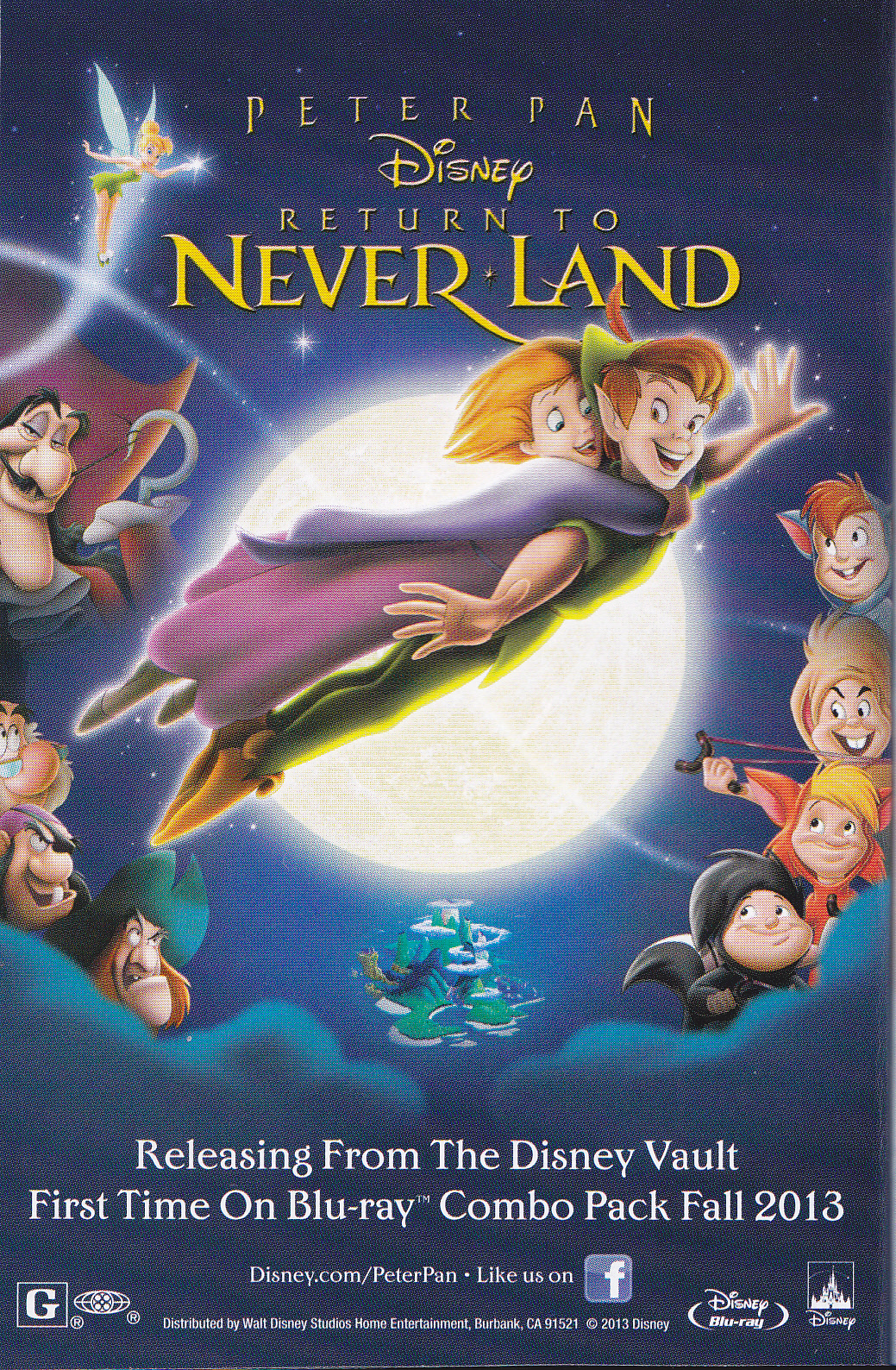
Return to Neverland News

An upcoming release revealed (appropriately) in the packaging for Peter Pan Diamond Edition:


Tuesday, November 20, 2012

Little Mermaid News

Disney has released the following advertisement for an upcoming release of The Little Mermaid (1989), the film that ushered in the Disney Renaissance: