In addition to the return of Winnie the Pooh and friends, Disney is also set to revisit the world of Mary Poppins in the upcoming film Mary Poppins Returns. Once again, the young children of the series are now grown-ups and struggling with issues they cannot handle alone until their childhood friend returns.
Here is the teaser from Disney:
Showing posts with label Preternatural/Supernatural. Show all posts
Showing posts with label Preternatural/Supernatural. Show all posts
Friday, March 9, 2018

Saturday, May 16, 2015
cfp The Fantastic: Positions from Another World (Panel at the SCLA) (4/15/15)
From H-Announce:
https://www.h-net.org/announce/show.cgi?ID=220807
NOTE EXPIRED DEADLINE
The Fantastic: Positions from Another World (Panel at the SCLA)
Location: Louisiana, United States
Conference Date: 2015-04-15
Date Submitted: 2015-03-01
Announcement ID: 220807
Panel for the Annual Meeting of the Society for Comparative Literature and the Arts.
Four Points by Sheraton
New Orleans, LA
October 15-17 2015
The Fantastic: Positions from Another World
“The fantastic is . . . a product of human imagination, perhaps even an excess of imagination. It arises when laws thought to be absolute are transcended, in the borderland between life and death, the animate and the inanimate, the self and the world . . . The fantastic is the unexpected occurrence, the startling novelty which goes contrary to all our expectations of what is possible. The ego multiplies and splits, time and space are distorted.”
― Franz Rottensteiner, The Fantasy Book: An Illustrated History From Dracula To Tolkien
Authors of the fantastic employ various strategies to create new worlds. Magic, ghosts, and the supernatural are only a few of the ways in which our world is transformed into something different, but not altogether alien. Whether it be a hidden world of monsters, a future world of robots and aliens, a past world of vampires, or a new world of dragons and elves, the fantastic allows authors to explore the positions created by the otherworldly. These positions have consequences for the subject’s relationship to the political, rhetorical, theoretical, ideological, sexual, psychological, cultural, and so on. This panel seeks submissions for papers that engage with all types of literature or multimedia whose authors or creators represent worlds outside, behind, or beside our own. Possible topics could include but are not limited to:
The supernatural
The magical
Horror
The gothic
Sci-fi
Fantasy
Myth
Romantic literature
Medieval literature
Magical realism
Please send 300-500 words abstracts to ccmoore@mailbox.sc.edu by April 15th, 2015.
Casey C. Moore
University of South Carolina
Email: ccmoore@mailbox.sc.edu
https://www.h-net.org/announce/show.cgi?ID=220807
NOTE EXPIRED DEADLINE
The Fantastic: Positions from Another World (Panel at the SCLA)
Location: Louisiana, United States
Conference Date: 2015-04-15
Date Submitted: 2015-03-01
Announcement ID: 220807
Panel for the Annual Meeting of the Society for Comparative Literature and the Arts.
Four Points by Sheraton
New Orleans, LA
October 15-17 2015
The Fantastic: Positions from Another World
“The fantastic is . . . a product of human imagination, perhaps even an excess of imagination. It arises when laws thought to be absolute are transcended, in the borderland between life and death, the animate and the inanimate, the self and the world . . . The fantastic is the unexpected occurrence, the startling novelty which goes contrary to all our expectations of what is possible. The ego multiplies and splits, time and space are distorted.”
― Franz Rottensteiner, The Fantasy Book: An Illustrated History From Dracula To Tolkien
Authors of the fantastic employ various strategies to create new worlds. Magic, ghosts, and the supernatural are only a few of the ways in which our world is transformed into something different, but not altogether alien. Whether it be a hidden world of monsters, a future world of robots and aliens, a past world of vampires, or a new world of dragons and elves, the fantastic allows authors to explore the positions created by the otherworldly. These positions have consequences for the subject’s relationship to the political, rhetorical, theoretical, ideological, sexual, psychological, cultural, and so on. This panel seeks submissions for papers that engage with all types of literature or multimedia whose authors or creators represent worlds outside, behind, or beside our own. Possible topics could include but are not limited to:
The supernatural
The magical
Horror
The gothic
Sci-fi
Fantasy
Myth
Romantic literature
Medieval literature
Magical realism
Please send 300-500 words abstracts to ccmoore@mailbox.sc.edu by April 15th, 2015.
Casey C. Moore
University of South Carolina
Email: ccmoore@mailbox.sc.edu
Wednesday, May 14, 2014
CFP Shakespeare and the Imaginary, Supernatural, and Divine (9/12/14; Columbus, OH 10/24-25/14)
"Lovers, Madmen and Poets: Shakespeare and the Imaginary, Supernatural, and Divine"
full name / name of organization:
Ohio Valley Shakespeare Conference
contact email:
nunn@akron.edu
The Ohio Valley Shakespeare Conference seeks papers and panels relating to all things Shakespearean, especially those focusing on the spectral, the fantastic, the mad, and the fey. We take our cue from Theseus: “Lovers and madmen have such seething brains, / Such shaping fantasies, that apprehend / More than cool reason ever comprehends.” The place of the world-beyond-the world, the line between reality and fantasy, and the demarcation of the sane from the mad are ever-present and controversial aspects of Shakespeare’s work and of early modern literature more broadly. As the plays we now call ‘romances’ or ‘dark comedies’ suggest, the transformation of the tragic into the comedic relies, to some extent, on the willing suspension of disbelief, on the capacity to accept what is otherwise contrary to our understanding, expectation, or experience. From Samuel Pepys’ condemnation of A Midsummer Night’s Dream, to the oblique resonances between Hamlet and Derrida’s Specters of Marx, the relationship between the ‘unreal’ and the ‘real’ is everywhere present and significant in Shakespeare’s works, and centrally a focus of performance history and critical reception from the earliest moments to the present. This conference will especially highlight these aspects of Shakespeare’s oeuvre.
Join us October 24-25, 2014 in Columbus, Ohio. Papers of 20 minutes, roundtable topics, and suggestions for panels on Shakespeare’s work and that of his contemporaries welcome.
The OVSC publishes a volume of selected papers each year and conferees are welcome to submit revised versions of their papers for consideration. Students who present are eligible to compete for the M. Rick Smith Memorial Prize.
Please send abstracts of 250 words to nunn@uakron.edu by September 12, 2014.
By web submission at 04/18/2014 - 13:00
full name / name of organization:
Ohio Valley Shakespeare Conference
contact email:
nunn@akron.edu
The Ohio Valley Shakespeare Conference seeks papers and panels relating to all things Shakespearean, especially those focusing on the spectral, the fantastic, the mad, and the fey. We take our cue from Theseus: “Lovers and madmen have such seething brains, / Such shaping fantasies, that apprehend / More than cool reason ever comprehends.” The place of the world-beyond-the world, the line between reality and fantasy, and the demarcation of the sane from the mad are ever-present and controversial aspects of Shakespeare’s work and of early modern literature more broadly. As the plays we now call ‘romances’ or ‘dark comedies’ suggest, the transformation of the tragic into the comedic relies, to some extent, on the willing suspension of disbelief, on the capacity to accept what is otherwise contrary to our understanding, expectation, or experience. From Samuel Pepys’ condemnation of A Midsummer Night’s Dream, to the oblique resonances between Hamlet and Derrida’s Specters of Marx, the relationship between the ‘unreal’ and the ‘real’ is everywhere present and significant in Shakespeare’s works, and centrally a focus of performance history and critical reception from the earliest moments to the present. This conference will especially highlight these aspects of Shakespeare’s oeuvre.
Join us October 24-25, 2014 in Columbus, Ohio. Papers of 20 minutes, roundtable topics, and suggestions for panels on Shakespeare’s work and that of his contemporaries welcome.
The OVSC publishes a volume of selected papers each year and conferees are welcome to submit revised versions of their papers for consideration. Students who present are eligible to compete for the M. Rick Smith Memorial Prize.
Please send abstracts of 250 words to nunn@uakron.edu by September 12, 2014.
By web submission at 04/18/2014 - 13:00
Monday, August 5, 2013
Extrapolation Open Call
 Not sure if I've posted this before--
 Extrapolation has the following open call for papers on its publisher's website:
Extrapolation was founded in 1959 by Thomas D. Clareson and was the first journal to publish academic work on science fiction and fantasy. It continues to be a leading, peer-reviewed, international journal in that specialized genre in the literature of popular culture.
It welcomes papers on all areas of speculative culture, including print, film, television, comic books and video games, and particularly encourages papers which consider popular texts within their larger cultural context.
The journal publishes a wide variety of critical approaches including but not limited to literary criticism, utopian studies, genre criticism, feminist theory, critical race studies, queer theory, and postcolonial theory. Extrapolation promotes innovative work which considers the place of speculative texts in contemporary culture. It is interested in promoting dialogue among scholars working within a number of traditions and in encouraging the serious study of popular culture.
We are particularly interested in the following areas of study:
- Racial constructions in speculative genres
- Children's and YA sf and fantasy
- Sexualities
- Fantastic motifs in mainstream texts
- Gender and speculative texts
- History of sf and fantasy
- New weird fiction
- Remakes, rewriting and retrofitting
- Pulp sf and fantasy
- The body in speculative texts
- Posthumanism
- Political sf and fantasy
- Non-Western speculative traditions
- Technoculture
Please email submissions to Javier A. Martinez (extrapolation@utb.edu )
Essays should be approximately 4000-9000 words, written according to MLA standards and include a 100 word abstract. Neither embedded footnotes nor generated footnotes that some software systems make available should be used. Electronic submissions in MS Word are encouraged. The editors aim to respond to submissions within three months. Please do not send simultaneous submissions of articles to other publications.
Friday, May 24, 2013
Sociology and Neil Gaiman Collect CFP (6/1/13)
Still catching up. Here is the first of 3 calls for papers with upcoming deadlines.
Magic and Dreams and Good Madness: Sociology and Neil Gaiman
Location: Ireland
Call for Papers Date: 2013-06-01 (in 8 days)
Date Submitted: 2013-03-12
Announcement ID: 202210
Neil Gaiman is considered one of the most popular authors of science fiction and fantasy alive today. He has written novels, short stories, film and television scripts, comic books and graphic novel series; and maintains an extremely prolific online presence through his blog, tumblr and twitter accounts. Some of his most popular works include The Sandman comics, the novels Coraline, American Gods, and Stardust, and two episodes of the popular British science fiction series Doctor Who. Gaiman has been the recipient of numerous awards, including the Hugo, Nebula, and The Bram Stoker Award. In 2009 he was awarded The Newberry Medal for children’s novel The Graveyard Book and the following year was also awarded The Carnegie Medal, becoming the first author ever to win both awards for the same work.
This collection will contain 20 essays inspired by the work of any of Gaiman’s publications over his career. His books, graphic novels and the movies they have inspired, provide endless possibilities for sociological analysis. This collection will be unique, encouraging the publication of chapters by those beginning their academic careers. It will prioritise submissions from graduate students currently working on their MA and PhD programs.
Suggested topics include, but are in no way limited to:
- Society and its portrayal
- Sexuality and the Erotic
- Prejudice
- Bodies and Embodiment
- The Law and the Criminal System
- Government and Politics
- Education Systems
- Gender, Race and Class
- Relationships (sexual, friendship, the family, magic, etc…)
- Human and Non-Human Rights
- Conformity and Deviance
- Socialisation
- Mental Health
Please submit proposed abstracts of 500 words, along with a 250 word biography in Microsoft Word format to goodmadnesscfp@gmail.com by June 1 2013.
Gráinne O'Brien and Alexandra Dunne
Email: goodmadnesscfp@gmail.com
Visit the website at http://goodmadnesscfp.blogspot.com/
Magic and Dreams and Good Madness: Sociology and Neil Gaiman
Location: Ireland
Call for Papers Date: 2013-06-01 (in 8 days)
Date Submitted: 2013-03-12
Announcement ID: 202210
Neil Gaiman is considered one of the most popular authors of science fiction and fantasy alive today. He has written novels, short stories, film and television scripts, comic books and graphic novel series; and maintains an extremely prolific online presence through his blog, tumblr and twitter accounts. Some of his most popular works include The Sandman comics, the novels Coraline, American Gods, and Stardust, and two episodes of the popular British science fiction series Doctor Who. Gaiman has been the recipient of numerous awards, including the Hugo, Nebula, and The Bram Stoker Award. In 2009 he was awarded The Newberry Medal for children’s novel The Graveyard Book and the following year was also awarded The Carnegie Medal, becoming the first author ever to win both awards for the same work.
This collection will contain 20 essays inspired by the work of any of Gaiman’s publications over his career. His books, graphic novels and the movies they have inspired, provide endless possibilities for sociological analysis. This collection will be unique, encouraging the publication of chapters by those beginning their academic careers. It will prioritise submissions from graduate students currently working on their MA and PhD programs.
Suggested topics include, but are in no way limited to:
- Society and its portrayal
- Sexuality and the Erotic
- Prejudice
- Bodies and Embodiment
- The Law and the Criminal System
- Government and Politics
- Education Systems
- Gender, Race and Class
- Relationships (sexual, friendship, the family, magic, etc…)
- Human and Non-Human Rights
- Conformity and Deviance
- Socialisation
- Mental Health
Please submit proposed abstracts of 500 words, along with a 250 word biography in Microsoft Word format to goodmadnesscfp@gmail.com by June 1 2013.
Gráinne O'Brien and Alexandra Dunne
Email: goodmadnesscfp@gmail.com
Visit the website at http://goodmadnesscfp.blogspot.com/
Friday, May 17, 2013
Popular Preternaturaliana Now Online
We've just launched a new endeavor called Popular Preternaturaliana: Studying the Monstrous in Popular Culture at http://popularpreternaturaliana.blogspot.com/. The site is sponsored
by the Science Fiction, Fantasy, and Legend Area and (like NEPCA Fantastic) hosted by The
Virtual Society for the Study of Popular Culture and the Middle Ages in the
hopes of providing a place to promote further study and debate of the
preternatural where ever and when ever
it may appear.
In the future, calls for papers and other postings relating to the monstrous, gothic, and horror can be found on the new site.
Michael A. Torregrossa
Science Fiction, Fantasy, and Legend Area Chair, Northeast Popular Culture/American Culture Association
Co-Founder, The Virtual Society for the Study of Popular Culture and the Middle Ages
In the future, calls for papers and other postings relating to the monstrous, gothic, and horror can be found on the new site.
Michael A. Torregrossa
Science Fiction, Fantasy, and Legend Area Chair, Northeast Popular Culture/American Culture Association
Co-Founder, The Virtual Society for the Study of Popular Culture and the Middle Ages
Thursday, May 2, 2013
Urban Fantasy and Paranormal Romance CFP (6/1/13)
Essay Collection: Urban Fantasy and Paranormal Romance
Publication Date: 2013-06-01 (in 30 days)
Date Submitted: 2013-02-05
Announcement ID: 201091
Articles about urban fantasy and romance novels are invited for a new, multi-contributor collection.
During the last few decades, urban fantasy and paranormal romance novels have come to the forefront in the publishing world. Normative heroes and heroines have been joined by werewolves, vampires, mermaids, shape-shifters, centaurs and dragons, to name but a few. These magical creatures fill the pages of books and the screens of movie theaters in ever-increasing numbers.
Such a vast industry—one that generated at least 75 million readers in 2008 alone (and has been growing since)—should not be disregarded. This collection will offer critical examinations of both urban fantasy and paranormal romance.
The following categories suggest possibilities but are by no means exhaustive:
• Gender
• Race
• Sexuality
• Romance
• Desire
• Domesticity
• Power
• Monstrosity
• Witchcraft
• Fandom and/or Reception
• Transformation and/or Adaptation
• Vampires, Shapeshifters, and other Supernatural Creatures
• Hybridity
• Heroism
• Villainy
• Memory
What to Send:
300 - 500 word abstracts (or complete articles, if available) and CVs should be submitted by June 1, 2013. If an abstract is accepted for the collection, a full draft of the essay (5000 – 8000 words) will be required by December 1, 2013.
Abstracts and final articles should be submitted to: paranormalromance.urbanfantasy@gmail.com
Margo Collins and Nadine Farghaly
Email: paranormalromance.urbanfantasy@gmail.com
Publication Date: 2013-06-01 (in 30 days)
Date Submitted: 2013-02-05
Announcement ID: 201091
Articles about urban fantasy and romance novels are invited for a new, multi-contributor collection.
During the last few decades, urban fantasy and paranormal romance novels have come to the forefront in the publishing world. Normative heroes and heroines have been joined by werewolves, vampires, mermaids, shape-shifters, centaurs and dragons, to name but a few. These magical creatures fill the pages of books and the screens of movie theaters in ever-increasing numbers.
Such a vast industry—one that generated at least 75 million readers in 2008 alone (and has been growing since)—should not be disregarded. This collection will offer critical examinations of both urban fantasy and paranormal romance.
The following categories suggest possibilities but are by no means exhaustive:
• Gender
• Race
• Sexuality
• Romance
• Desire
• Domesticity
• Power
• Monstrosity
• Witchcraft
• Fandom and/or Reception
• Transformation and/or Adaptation
• Vampires, Shapeshifters, and other Supernatural Creatures
• Hybridity
• Heroism
• Villainy
• Memory
What to Send:
300 - 500 word abstracts (or complete articles, if available) and CVs should be submitted by June 1, 2013. If an abstract is accepted for the collection, a full draft of the essay (5000 – 8000 words) will be required by December 1, 2013.
Abstracts and final articles should be submitted to: paranormalromance.urbanfantasy@gmail.com
Margo Collins and Nadine Farghaly
Email: paranormalromance.urbanfantasy@gmail.com
Saturday, April 27, 2013
Time Travel in the Media CFP (6/16/13)
 CFP: Time Travel in the Media edited collection
Call for Papers Date: 2013-06-16
Date Submitted: 2013-03-18
Announcement ID: 202340
We are currently seeking chapter proposals for the first collection of essay to address time travel across different media formats. The collection, to be be published by McFarland, will be edited by Joan Ormrod (Manchester Metropolitan University) and Matthew Jones (UCL).
Time travel has been a topic that has fascinated the media since the 19th century. Indeed, cinema has used flashbacks and montage since its earliest days to experiment with time. However, film is not the only medium fascinated by the concept. Television series such as Doctor Who (1963-1989, 1996 and 2005-present), Quantum Leap (1989-1993), The Time Tunnel (1966-1967) and Torchwood (2006-2011) explore history and play with notions of time as a social construct. Video games, manga and animé also examine time travel's unique narrative possibilities, for instance in The Legend of Zelda: The Ocarina of Time (1998) or Final Fantasy XIII-2 (2011). Graphic novels such as Watchmen (1986-1987) and superhero narratives use time travel to explore heroes’ ingenuity and the problems created by paradoxes.
Time travel narratives have invoked socio-historic concerns for subjectivity, narrativity, history, the future and potential apocalypse. The future and the past are frequently depicted as a means of understanding the problems of the present. Lately, time travel narratives have used philosophical issues based on scientific theories such as string theory, multiple universes and the philosophical construction of time. Contemporary time travel stories also acknowledge the potential for experimentation in media narratives. Such diversity surely requires more scrutiny in academic discourse. This collection of essays will be the first dedicated solely to the topic.
The collection is aimed at:
• undergraduate and postgraduate students in film and media, cultural studies, philosophy, social sciences, history and science programmes.
• science fiction and fantasy fandoms across a range of media.
The volume will address a broad range of media, including television, cinema, video games, anime and manga, comics and graphic novels and radio plays. It will be divided into five sections addressing narrative and media form, time travel as genre, philosophical and theoretical concepts, time and culture and a number of case studies
We are currently inviting 500-word proposals for 5000-7000 word chapters. These might address, but need not be limited to, the following topics:
• Adaptation and the differences between time in media forms
• Parallel worlds/alternative realities in virtual media, gaming and avatars
• Narrative devices such as the causal time loop
• Cinematic and media apparatus as time machine
• Experimental and avant garde depictions of time and time travel
• Narrative tropes
• Key characters - H. G. Wells, The Doctor, Sam Becket, Marty McFly
• Iconography - the time travel machine, distinguishing the past/future from the present
• The adaptability of the time travel narrative to many genres - science fiction, fantasy, romance, teenpics
• The depiction of history and historical characters
• The rules and regulations of time travel and parallel worlds
• The experience and means of time travel (machine, magic, supernatural)
• Use of specific theoretical models of narrative interrogation, such as psychoanalytic, carnivalesque, discursive, Deleuzian, Ricoeur, Bergson, postmodern and semiotic perspectives or new theoretical contexts
• Philosophical considerations, such as free will and determinism, religious and ritualistic perspectives
• String theory and parallel universes
• Socio-historic notions of time (linear time, cyclical time, the Enlightenment and the mythic)
• Tourism - cosmopolitanism, the flâneur
• Time-travel narratives within the context of their socio-historic production
• Case studies which examine a specific aspect of time travel in one text.
Proposals along with a 50 word biography should be sent to timetravelcollection@gmail.com
Deadline: 16 June 2013
Joan Ormrod
Manchester Metropolitan University
Chatham 307
Manchester 44 161 247 1938
Email: timetravelcollection@gmail.com
CW's Superrnatural CFP (5/15/13)
 One more from supernaturaltelevision@gmail.com for the night:
Essay Collection: CW's "Supernatural" television
Publication Date: 2013-05-15 (in 18 days)
Date Submitted: 2013-01-22
Announcement ID: 200641
Articles are invited for an edited collection on issues related to any element of the CW television series Supernatural.
The following categories suggest possibilities but are by no means exhaustive:
• Monstrosity
• Fandom and/or Reception
• Transformation and/or Adaptation
• Gender
• Race
• Desire and Sexuality
• Hybridity
• Vampires
• Shapeshifters
• Ghosts and Hauntings
• Demons and Angels
• Heroism
• Villainy
• Desire
• History and Memory
• Family
• Power
• Possession and/or Mind Control
What to Send: 300 - 500 word abstracts (or complete articles, if available) and CVs should be submitted by May 15, 2013. If an abstract is accepted for the collection, a full draft of the essay (5000 – 8000 words) will be required by October 15, 2013.
Abstracts and final articles should be submitted to supernaturaltelevision@gmail.com. Please include “Supernatural Submission” in your subject line.
Dr. Margo Collins
Email: supernaturaltelevision@gmail.com
MTV's Teen Wolf Collection CFP (6/1/13)
 Essay Collection: MTV's Teen Wolf
Publication Date: 2013-06-01
Date Submitted: 2013-02-19
Announcement ID: 201568
Articles are invited for an essay collection on the new MTV serial remake of Teen Wolf. In “Upright Citizens on All Fours: Nineteenth-Century Identity and the Image of the Werewolf,” Chantal Bourgault du Coudray notes that ‘an ever-growing body of scholarship utilises the concept of hybrid or heterogeneous identity. The hybrid identity is theorised and celebrated as a response to the demands of a fragmented, multi-dimensional, postmodern world, one in which shifting boundaries and a multiplicity of subject positions make it impossible to assume a homogeneous or stable subjectivity.’ Theorists such as Katherine Hayles and Donna Haraway discuss the implications of hybridity in the posthuman. Asa Simon Mittman and Peter J. Dendle deal with the monstrosity of hybridity. Many critics discuss iterations of the werewolf in literature and film. This volume aims to discuss the new MTV serial remake of Teen Wolf in terms of its connection to the popular and literary culture, though other approaches are welcome, as well.
The following categories suggest possibilities but are by no means exhaustive:
• Monstrosity and/or Hybridity
• Fandom and/or Reception
• Personal Transformation and/or Adaptation
• Genre Transformation and/or Adaptation
• Gender
• Race
• Desire and Sexuality
• Heroism and/or Villainy
• History and Memory
• Family
• Power
We are also interested in the intersections of Teen Wolf with:
• the werewolf in 19th century literary history
• the werewolf in 20th century literary history
• post humanism in teen culture
• the werewolf in the 1980s
• the werewolf in Comics (such as the werewolf in Dell comics, Marvel comics, Legends of the Dark Night)
• the werewolf in fairy tales and/or folk mythology
• the werewolf in American pulp fiction
• the werewolf in children’s literature
• the werewolf in adult television (True Blood, Doctor Who, Sanctuary, Grimm)
• the werewolf in games or anime
What to Send: 300 - 500 word abstracts (or complete articles, if available) and CVs should be submitted by June 1, 2013. If an abstract is accepted for the collection, a full draft of the essay (5000 – 8000 words) will be required by January 1, 2014.
Abstracts and final articles should be submitted to supernaturaltelevision@gmail.com. Please include “Teen Wolf Submission” in your subject line.
Dr. Kamille Stone Stanton
supernaturaltelevision@gmail.com
Email: supernaturaltelevision@gmail.com
Friday, March 22, 2013
Thursday, March 21, 2013
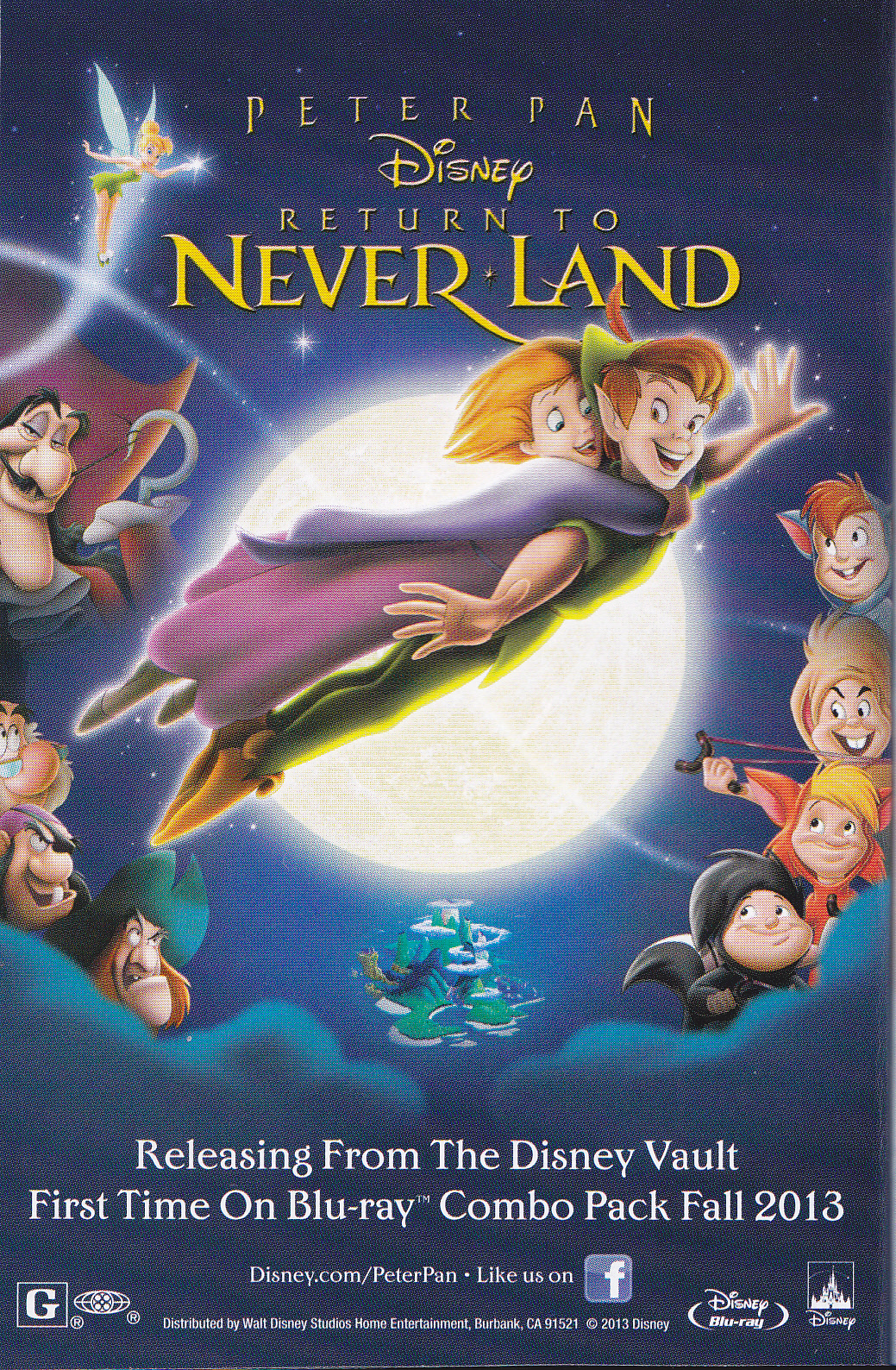
Return to Neverland News
An upcoming release revealed (appropriately) in the packaging for Peter Pan Diamond Edition:

Friday, November 30, 2012
Essential Supernatural Out Now

Knight, Nicholas, and Christopher Cerasi. The Essential Supernatural: On the Road with Sam and Dean Winchester. Foreword Eric Kripke. San Rafael, CA: Insight Editions, 2012. Print. 978-1-60887-145-2
Profusely illustrated, this over-sized book serves as both a guide to and celebration of the first seven seasons of the Supernatural television series. The book includes a wealth of photographs from the show, commentary by the cast and crew, and a variety of extras for the fans. The book concludes with predictions for the upcoming season eight and a short episode guide devoted to seasons one through seven.
Tuesday, November 20, 2012
Sunday, October 14, 2012
Halloween at Design Toscano
Design Toscano offers a wealth of Halloween- and Gothic-themed products (including zombies, vampires, skeletons, reapers, witches, and, of course, their signature gargoyles) at their website. Details and images at http://www.designtoscano.com/category/more+themes/halloween+decor.do?sortby=bestSellers&page=all.
Monday, September 10, 2012
ALA Gothic Symposium CFP
Call for Papers (PDF)
American Literature Association Symposium
“Fear and Form:
Aspects of the Gothic in American Culture”
Keynote Speakers:
Teresa A. Goddu, Vanderbilt University
Eric Savoy, University of Montreal
February 21-23, 2013
ALA symposia provide opportunities for scholars to meet in pleasant settings, present papers, and share ideas and resources. The February 2013 symposium will meet in the self-proclaimed “most haunted city in America” and focus on the role of the Gothic in American literary culture. We welcome proposals for presentations on the place of the Gothic in the writings of both popular and canonical American authors (Brown, Poe, Hawthorne, Faulkner, O’Connor, Wright, Morrison, and others). We are particularly interested in studies relating Gothic modes to other forms, including the historical novel, poetry, the graphic novel, and detective fiction. In addition, we welcome studies exploring the roles of ghosts, vampires, demons, zombies, haunted houses, ancestral curses in American literary culture, including film. Proposals for panels and roundtable discussions are also encouraged.
Location: Hyatt Regency Savannah
Two W. Bay Street
Savannah, Georgia 31401
Hotel Rate: The Hyatt is offering a special rate of $150 (plus tax) per night for a single or double room.
Conference Fee: $150 (includes two meals and two receptions)
Conference Directors:
Alfred Bendixen, Texas A & M University
Rene H. Trevino, Texas A & M University
Please email all proposals to Rene Trevino
trevinreo@tamu.edu
Before October 1, 2012
Conference Details: The American Literature Association will meet in the Hyatt Regency in Savannah for a symposium on the Gothic in American Culture, February 21-23, 2013.
Please plan to stay in the conference hotel as this helps us meet our commitment to the hotel and keeps our rates low. The Hyatt is ideally located on the waterfront and right next to the largest historic district in the United States.
Sessions run Friday and Saturday, February 22-23. On Friday September 22rd, there will be a luncheon as well as an evening reception featuring a key note speaker. The second luncheon will be Saturday February 24, with a closing keynote and reception scheduled for the evening. Meal preferences will be sent to conference participants at a later date. The conference fee of $150 includes two lunches and two receptions.
Individuals may propose papers or panels by emailing the conference director, Rene Trevino, at trevinreo@tamu.edu no later than October 1, 2012. The proposal should include the title of the presentation or panel, an abstract that provides the conference director with a clear idea of the material that will be covered, a brief vita or description of the presenter’s qualifications, and complete emails for all participants. The proposal should be both pasted into an email and sent as an attachment (preferably in WORD). All emails will be acknowledged in a timely manner. The conference directors welcome proposals for roundtables and panels that deal with the development of important genres and literary movements.
Please note that no audiovisual equipment will be available for the symposium.
Those proposing papers and/or panels will be informed of acceptances in mid October Participants will be asked to make their hotel reservations immediately and to pre-register using the material posted at the end of this announcement. A program will be placed on the website prior to the conference and printed programs will be available at the symposium.
ALA Guidelines: The most common ALA format is a time slot of one hour and twenty minutes with three papers and a chair. This permits time for discussion and three papers of approximately 20 minutes (or nine typed double-spaced pages). Organizers of panels are free to use other formats provided they respect the time limits. Furthermore, the ALA encourages panel organizers to experiment with innovative formats including discussion groups and panels featuring more speakers and briefer papers. Chairs will make sure that the panels start and end on time and that no speaker goes beyond the allotted time limit. We prefer that chairs not present papers on the panels that they are moderating, and no one may present more than one paper at an ALA symposium.
The conference fee covers the costs of the conference including two meals and two receptions. We encourage all of those who are on the program to pre-register. The conference fee is $150 for all participants. We regret that we are unable to offer a lower rate for graduate students and independent scholars for this symposium.
ALA Membership: Membership in the ALA is not required in order to propose or present a paper. In fact, technically the members of the American Literature Association are the various author societies. Individuals may keep informed about the activities of the ALA by checking our website (www.americanliterature.org), which is the primary source for information about ALA activities
The easiest way to find out about the conference and all ALA activities is by consulting our website: www.americanliterature.org
Please note that the American Literature Association maintains the lowest conference fees of any major scholarly organization because it operates without a paid staff. If you have any questions that are not answered by this announcement, please contact the conference director or Alfred Bendixen, Executive Director of the ALA, at abendixen@tamu.edu.
Tuesday, August 7, 2012
Dead Inside (Zombie Collection) CFP Update
UPDATE. CFP The Walking Dead, Essay Collection.
Call for Papers Date: 2012-08-13 (in 6 days)
Date Submitted: 2012-07-17
Announcement ID: 195841
UPDATE for The Walking Dead, Essay Collection: I will also be accepting PROPOSALS for articles for this essay collection by the August 13, 2012 deadline (although ideally the essays should be underway)
Dead Inside: The Walking Dead and the Problem of Meaning in the New Millennium
In the early twenty-first century, zombies are everywhere—in film (Land of the Dead, 28 Days Later, Dead Snow, Rammbock, The Horde), fiction (Stephen King’s Cell, Colson Whitehead’s Zone One, Max Brooks’ World War Z, John Ajvide Lindqvist’s Handling the Undead), social movements (zombie walks and the Zombie Research Society ), classrooms (Zombie Studies) and even politics (Daniel Drezner’s Theories of International Politics and Zombies). Undoubtedly one of the most sustained and complex representations of the modern zombie, though, is AMC’s television series, The Walking Dead, based on Robert Kirkman’s series of comics.
I am seeking essays for a scholarly collection that will explore the complexities of The Walking Dead in relation to the multiple forms of zombie revival, and that will address the ways in which the zombie articulates the crucial theoretical and political debates of the new century.
I am particularly interested in essays about how zombies, and narratives about zombies, engage problems of meaning. In the first episode of season one of The Walking Dead, after protagonist Rick Grimes wakes up in a hospital to a post-apocalyptic world, he encounters a door on which the words “Do Not Open. Dead Inside” are painted. Zombies claw at the opening. The moment encapsulates how zombies often function to signal loss or lack—of self, of consciousness, of history, of political efficacy, of meaning itself. How does the series, in its many contexts—literary, cinematic, historical, political—address compelling contemporary problems of meaning, of how we find and attribute significance in our lives. Essays should, then, take up The Walking Dead as a crystallization of one of the many contemporary problems of meaning. Some generative questions/contexts include:
--Why have zombies seen such a resurgence in the twenty-first century, after their apparent demise in the 1990s? How does The Walking Dead represent an evolution in the history of zombie fiction and film?
--How do zombies feature in imaginings of the end of the world? How do post-apocalyptic narratives with zombies (The Walking Dead, World War Z, Romero’s Dead cycle) differ from those without (The Road, Survivors, Jericho)?
--How do fictional, cinematic, and televisual zombies illuminate philosophical debates over the conceivability of the zombie and what the possible existence (or lack thereof) of zombies says about human consciousness and identity?
--How do zombie narratives encode politics and offer forms of social critique (notably of global capitalism), as well as embodying forms of utopian political thinking?
--How do zombies serve as figures of contagion—as a virus that infects both the body and the mind (memes, flash mobs, etc.)? What meanings inhere in zombies’ contagiousness?
--How do zombies engage with recent theorists of the posthuman?
Please send your essay of no more than 30 pages to Dawn Keetley, Associate Professor of English, at Lehigh University, 35 Sayre Drive, Bethlehem PA 18015. Email: dek7@lehigh.edu. The deadline is Monday August 13, 2012. All disciplinary and interdisciplinary perspectives are welcome. I will be happy to address any questions via email at any time. I am in communication with McFarland (which has been publishing the best books on zombies) about a contract for the collection.
Dawn Keetley
Department of English
Lehigh University
Drown Hall
Bethlehem PA 18015
(610) 758-5926
Email: dek7@lehigh.edu
Call for Papers Date: 2012-08-13 (in 6 days)
Date Submitted: 2012-07-17
Announcement ID: 195841
UPDATE for The Walking Dead, Essay Collection: I will also be accepting PROPOSALS for articles for this essay collection by the August 13, 2012 deadline (although ideally the essays should be underway)
Dead Inside: The Walking Dead and the Problem of Meaning in the New Millennium
In the early twenty-first century, zombies are everywhere—in film (Land of the Dead, 28 Days Later, Dead Snow, Rammbock, The Horde), fiction (Stephen King’s Cell, Colson Whitehead’s Zone One, Max Brooks’ World War Z, John Ajvide Lindqvist’s Handling the Undead), social movements (zombie walks and the Zombie Research Society ), classrooms (Zombie Studies) and even politics (Daniel Drezner’s Theories of International Politics and Zombies). Undoubtedly one of the most sustained and complex representations of the modern zombie, though, is AMC’s television series, The Walking Dead, based on Robert Kirkman’s series of comics.
I am seeking essays for a scholarly collection that will explore the complexities of The Walking Dead in relation to the multiple forms of zombie revival, and that will address the ways in which the zombie articulates the crucial theoretical and political debates of the new century.
I am particularly interested in essays about how zombies, and narratives about zombies, engage problems of meaning. In the first episode of season one of The Walking Dead, after protagonist Rick Grimes wakes up in a hospital to a post-apocalyptic world, he encounters a door on which the words “Do Not Open. Dead Inside” are painted. Zombies claw at the opening. The moment encapsulates how zombies often function to signal loss or lack—of self, of consciousness, of history, of political efficacy, of meaning itself. How does the series, in its many contexts—literary, cinematic, historical, political—address compelling contemporary problems of meaning, of how we find and attribute significance in our lives. Essays should, then, take up The Walking Dead as a crystallization of one of the many contemporary problems of meaning. Some generative questions/contexts include:
--Why have zombies seen such a resurgence in the twenty-first century, after their apparent demise in the 1990s? How does The Walking Dead represent an evolution in the history of zombie fiction and film?
--How do zombies feature in imaginings of the end of the world? How do post-apocalyptic narratives with zombies (The Walking Dead, World War Z, Romero’s Dead cycle) differ from those without (The Road, Survivors, Jericho)?
--How do fictional, cinematic, and televisual zombies illuminate philosophical debates over the conceivability of the zombie and what the possible existence (or lack thereof) of zombies says about human consciousness and identity?
--How do zombie narratives encode politics and offer forms of social critique (notably of global capitalism), as well as embodying forms of utopian political thinking?
--How do zombies serve as figures of contagion—as a virus that infects both the body and the mind (memes, flash mobs, etc.)? What meanings inhere in zombies’ contagiousness?
--How do zombies engage with recent theorists of the posthuman?
Please send your essay of no more than 30 pages to Dawn Keetley, Associate Professor of English, at Lehigh University, 35 Sayre Drive, Bethlehem PA 18015. Email: dek7@lehigh.edu. The deadline is Monday August 13, 2012. All disciplinary and interdisciplinary perspectives are welcome. I will be happy to address any questions via email at any time. I am in communication with McFarland (which has been publishing the best books on zombies) about a contract for the collection.
Dawn Keetley
Department of English
Lehigh University
Drown Hall
Bethlehem PA 18015
(610) 758-5926
Email: dek7@lehigh.edu
Monday, June 11, 2012
Thursday, June 7, 2012
Lost Girls on Syfy
Syfy recently aired a paranormal series called Lost Girl. Wikipedia includes a good introduction to the series, while Syfy has provided this clip on its YouTube channel:
Thursday, May 31, 2012
Odd Life of Timothy Green
I thought I had posted on this before:
The Odd Life of Timothy Green, a fantasy film due out this summer from Disney:
The Odd Life of Timothy Green, a fantasy film due out this summer from Disney:
Subscribe to:
Posts (Atom)