Showing posts with label Fairy Tales. Show all posts

Sunday, February 2, 2025

CFP 2025 Conference of The Incredible Nineteenth Century: Science Fiction, Fantasy, and Fairy Tale (3/28/2025; online 5/2-3/2025)


2025 Conference of The Incredible Nineteenth Century: Science Fiction, Fantasy, and Fairy Tale

deadline for submissions: 
March 28, 2025
full name / name of organization: 
The Incredible Nineteenth Century: Science Fiction, Fantasy, and Fairy Tale
contact email: 

Our third annual conference on May 2-3 via Zoom! This online conference is free to attend. Please use this link to register to present or attend: https://docs.google.com/forms/d/e/1FAIpQLSeSiuxTNYFJPUPxF1gAdfH1pQthfjig...

Submissions may cover any aspect of literature, film, or art related to science fiction, fantasy, or fairy tale in the Long Nineteenth Century (approximately 1789 to 1918). Also welcome are presentations on tv, film, and video game adaptations of nineteenth-century texts, or on works that re-envision the nineteenth century through science fiction or fantasy. Submissions to present are due by March 28.

Our keynote address will be delivered by Dr. Ann Schmiesing of the University of Colorado. She is the author of the recent book, _The Brothers Grimm: A Biography_.

Sunday, October 13, 2019

CFP Myth and Fairy Tales Area (10/31/2019; SWPACA 2/19-22/2020)

Call for Papers: Myth and Fairy Tales at Southwest Popular/American Culture Association (SWPACA) 2020
https://call-for-papers.sas.upenn.edu/cfp/2019/09/17/call-for-papers-myth-and-fairy-tales-at-southwest-popularamerican-culture-association


deadline for submissions: October 31, 2019

full name / name of organization: Southwest Popular/American Culture Association

contact email: sheila.dooley@utrgv.edu


Call for Papers

Myth and Fairy Tales

Southwest Popular / American Culture Association (SWPACA)


41st Annual Conference, February 19-22, 2020

Hyatt Regency Hotel & Conference Center

Albuquerque, New Mexico

http://www.southwestpca.org

Proposal submission deadline: October 31, 2019


Proposals for papers and panels are now being accepted for the 41st annual SWPACA conference.  One of the nation’s largest interdisciplinary academic conferences, SWPACA offers nearly 70 subject areas, each typically featuring multiple panels.  For a full list of subject areas, area descriptions, and Area Chairs, please visit http://southwestpca.org/conference/call-for-papers/


All scholars working in the areas of myth and/or fairy tales are invited to submit paper or panel proposals for the upcoming SWPACA Conference. Panels are now forming on topics related to all aspects of myths and fairy tales and their connections to popular culture. To participate in this area, you do not need to present on both myths and fairy tales; one or the other is perfectly fine. Presentations considering both genres are of course welcome and can stimulate interesting discussions. Proposals for forming your own Myth or Fairy Tale-focused panel – especially panels focused on one particular myth/tale – are encouraged.

Paper topics might include (but are certainly not limited to):


  • Where Fairy Tales and Myth Overlap
  • Non-Western Myths and Fairy Tales
  • Revised Fairy Tales
  • Fairy Tales in/as “Children’s Literature”
  • Disney
  • Urban Fairy Tales
  • Ethnic Myths and Fairy Tales
  • Gendered Readings of Myths and Fairy Tales
  • Postcolonial Myths and Fairy Tales
  • Myths and Fairy Tales in Advertising Culture
  • Reading Myths and Fairy Tales in the Popular Culture of Past Centuries
  • Performing Myths and Fairy Tales: Drama and/or Ritual
  • Genres of Myths and/or Fairy Tales: Film, Television, Poetry, Novels, Music, Comic Books, Picture Books, Short Stories, or Graphic Novels


All proposals must be submitted through the conference’s database at http://register.southwestpca.org/southwestpca


For details on using the submission database and on the application process in general, please see the Proposal Submission FAQs and Tips page at http://southwestpca.org/conference/faqs-and-tips/


Individual proposals for 15-minute papers must include an abstract of approximately 200-500 words. Including a brief bio in the body of the proposal form is encouraged, but not required.


For information on how to submit a proposal for a roundtable or a multi-paper panel, please view the above FAQs and Tips page.


The deadline for submissions is October 31, 2019. 

SWPACA offers monetary awards for the best graduate student papers in a variety of categories. Submissions of accepted, full papers are due January 1, 2020.  For more information, visit http://southwestpca.org/conference/graduate-student-awards/


Registration and travel information for the conference is available at http://southwestpca.org/conference/conference-registration-information/


In addition, please check out the organization’s peer-reviewed, scholarly journal, Dialogue: The Interdisciplinary Journal of Popular Culture and Pedagogy, at http://journaldialogue.org/

If you have any questions about the Myth and Fairy Tales area, please contact its Area Chair, Sheila Dooley, University of Texas Rio Grande Valley (UTRGV), Sheila.dooley@utrgv.edu


We look forward to receiving your submissions!


Last updated September 23, 2019
This CFP has been viewed 213 times.

Saturday, June 30, 2018

CFP Journal Issue on Tim Burton (Spec Issue of Parol: Qauderni d'Arte e di Epistemologia) (expired)

Sorry to have missed posting this earlier; it is certainly a publication worth looking out for:

Journal Issue on Tim Burton
https://call-for-papers.sas.upenn.edu/cfp/2018/03/16/journal-issue-on-tim-burton

deadline for submissions: May 15, 2018

full name / name of organization: Dr. Antonio Sanna

contact email: isonisanna@hotmail.com


Journal Issue on Tim Burton

Edited by Antonio Sanna

Tim Burton is certainly one of the most popular directors of contemporary Hollywood. His oeuvre includes blockbuster films such as Batman (1989), Planet of the Apes (2001) and Alice in Wonderland (2010) as well as less profitable– but still highly recognizable - films such as Ed Wood (1994). His work with stop motion, evident in Tim Burton’s The Nightmare Before Christmas (1993), Tim Burton’s Corpse Bride (2005) and the recent Frankenweenie (2013) has further popularized and updated a technique that has been fundamental in cinema since the silent era. His distinctive and personal touch, a visionary style that is now referred to as “Burtonesque”, and his frequent collaborations with Johnny Depp, Helena Bonham Carter and Danny Elfman (to mention merely a few) has contributed to establish a unique and identifiable brand.

The Italian academic and peer-reviewed journal Parol: Qauderni d'Arte e di Epistemologia will dedicate one of its next issues to the artistic production of the American director, including a total of six/seven papers on the subject, that explore Burton’s multi-medial oeuvre from multidisciplinary perspectives. The issue will be edited by Antonio Sanna, co-editor of the volume A Critical Companion to Tim Burton (Lexington Books, 2017). The editor seeks previously-unpublished essays that explore the American director’s heterogeneous career, and is particularly interested in interdisciplinary approaches to the subject that can illuminate the diverse facets of the Burton’s work and his unique visual style.

There are several themes worth exploring when analyzing Burton’s works, utilizing any number of theoretical frameworks of your choosing. The editor requests the papers to be based on formal analysis and to use an academic language. Papers on the visual style of Burton will be particularly appreciated, but contributions may include the following topics:

  • Burton and the visual arts
  • Humour, Black Humour and the Macabre
  • Burton and fairy tales
  • Gender and queer readings
  • Neo-Victorian art
  • Exploration of dreams and the subconscious
  • Fascination with machines and ecocriticism
  • Mob mentality
  • Alienation and misperception, conformity/nonconformity
  • Disfigurement, deformity and (dis)ability
  • Death and the afterlife
  • Intertextuality
  • Adaptations, Remakes and Appropriations
  • Music and Danny Elfman
  • Tim Burton in/and translation
  • Evil Clowns
  • Fan practice and fan communities

The journal issue will be organized around these topics and others that emerge from submissions. I am open to works that focus on other topics as well and authors interested in pursuing other related lines of inquiry. Feel free to contact the editor with any questions you may have about the project and please share this announcement with colleagues whose work aligns with the focus of this volume.

Submit a 300-500 word abstract of your proposed paper contribution, a brief CV and complete contact information in a single word file to Dr. Antonio Sanna (isonisanna@hotmail.com) by 15 May, 2018. Full chapters of 4000-6000 words will be due by 1 July, 2018 at the latest. Note: all full chapters submitted will be included subject to review.

Thursday, June 7, 2018

CFP Literary Fantasy and its Discontents Conference (8/31/18; Taipei 11/23/24/2018)


 Literary Fantasy and its Discontents

deadline for submissions: 
August 31, 2018
full name / name of organization: 
Taipei Tech (National Taipei University of Technology)
contact email: 
In her still influential Fantasy and Mimesis: Responses to Reality in Western Literature (1984), Kathryn Hume defines the literary fantastic as any departure from consensus reality, believing that it holds an equally significant position in literary history as mimesis. Rather than being a recent and sometimes academically marginalized genre, fantasy, for Hume, is integral to almost all literature.
The dialectics between literary fantasies and consensus reality have recently become more relevant than ever: current events remind us of how elusive consensus reality can be. This conference takes this concern over (un)reality as a jumping-off point for our theme: Literary Fantasy and Its Discontents. We hope to have a broad cross-section of papers that consider fantasy in its many forms: both as a (frequently politicized) literary genre or mode and in the word fantasy’s broader meanings of delusion, unconscious wish, or falsehood. How do fantasies assist in the formation of national identities? How do they impact the narratives––be they harmful or beneficial––that nations and people groups tell themselves about their origins, their capabilities, and their future? How do reader responses to the fantastic in literature differ from responses to texts that are predominantly mimetic, and how do these differences condition reception history? How has the fantastic been used in reform movements and the rhetoric of reaction? What are the ethics of literary fantasies (or the fantastic mode), and how have they been applied?

We welcome papers on any topic related to our theme. We hope to have several panels on texts from the medieval, early modern, eighteenth-century, Romantic, Victorian, and twentieth- and twenty-first century periods. While most papers given at this conference will address Anglophone literatures, we also welcome papers (in English) that address non-English or non-literary texts from other regions. As our conference is in Taipei, Taiwan, we particularly hope to organize several panels that address how literary fantasies have been celebrated, used, criticized, or abused in Asia. We are also interested in explorations of the reception history of Western fantasies in the East and Eastern fantasies in the West.

Our keynote speakers are Marysa Demoor (Ghent University) and Ackbar Abbas (University of California, Irvine). Marysa Demoor is author or editor of nearly twenty books, predominately on British and European literature, including the Dictionary of Nineteenth-century Journalism. Her early publications were on folklorist, fairy-tale collector, and journalist, Andrew Lang, and her current research interests include identity, nationhood and histoire croisée. Ackbar Abbas (Hong Kong: Culture and the Politics of Disappearance) is currently working on several projects: a book on ‘Posthumous Socialism’ about China and Hong Kong; a collaborative volume on ‘Volatility’ in contemporary culture and finance; and another volume which he will be co-editing on ‘Poor Theory’.  Abbas's keynote speech is entitled “Documentary As Fantasy; or, Documentary in the Era of Its Impossibility.”

Paper topics include but are not limited to:

  • National Epics (The Epic of Gilgamesh, The Iliad, Beowulf, Ossian, Le Morte D’Arthur, the Kalevala, Icelandic Sagas and the Poetic and Prose Eddas, etc.)
  • Classical Chinese Novels and Nationalism or Politics: Romance of the Three Kingdoms, Water Margin, Journey to the West, Dream of the Red Chamber 
  • The politics of or within best-selling literary fantasies such as The Lord of the Rings, the Gormenghast trilogy, The Master and Margarita, The Books of Earthsea, Harry Potter, His Dark Materials, Game of Thrones and others
  • Nineteenth-century Fairy Tale Collectors such as the Brothers Grimm, Andrew Lang, and the members of the Folk-Lore Society, and their collections
  • Racial Theories and Nationalism, Politics, or (fantastic) Literature, (Matthew Arnold, Ernest Renan, Robert Knox, etc.)
  • German philology, folklore, and twentieth-century Nazism
  • White nationalism and pseudo-history (Vikings, Anglo-Saxons, etc.)
  • Magical Realism and National Identities
  • Fantasy and Orientalism
  • Fantasy and Taiwanese Identity
  • Fantasy and Chinese identity
  • Taiwanese or Chinese nationalisms
  • Japanese fantasy and Taiwanese identity (from the Japanese colonial period to the present)
  • Fantasy and nationalism in Scotland, Wales, Ireland, Catalonia, etc.
  • Colonial and Post-colonial nationalisms and literary fantasies
  • Political satires written in the fantastic genre such as Gulliver’s Travels 
  • Utopias and/or Dystopias
  • Sexual Politics and Fantasy (“The Wife of Bath’s Tale,” the Arabian Nights, Game of Thrones, etc.)
  • Early Modern writers, fantasy, politics, and nationalism (Shakespeare, Marlowe, Spenser, Milton, etc.)
  • Medievalism (in art, literature, TV and film, gaming, etc.)
  • Victorian fantasists and politics: William Morris, Charles Kingsley, George MacDonald, Lewis Carroll, Christina Rossetti, Dinah Mulock, Margaret Oliphant, Tennyson, etc.
  • Travelers’ Tales and Nationalism
  • Politics and nationalism in children’s literary fantasies
  • Fantasy and environmentalism or fantasy and climate change
  • Fantasy and revolutions (The French Revolution, the Godwinian school, the work of particular Romantic poets, fantasy and European revolutions, etc.)
  • Fantasy and national or ethnic identities
  • Politicized fantasies
  • Politicized Reception histories of fantasy
  • Mao Zedong’s theory of literature and art, later Communist theories of art
  • Marxism and fantasies
  • Oral Histories and/or Folktales and Cultural Identity
  • Fantasy and the Cultural Industry
  • Literary fantasy and its publishers
  • The international diffusion and reception history of national fantasies across borders
  • Repressive governments such as ISIS and North Korea, and their national fantasies
  • Politics, Literature, and “Alternative Facts”
  • Escapism
  • Literary Fantasy and Radical Technologies


Please  submit a 250–300 word abstract and the requested presenter information in one Word or PDF file to the conference e-mail address, LFAIDTaipei@gmail.com, by Friday, August 31, 2018.

We also have an early-consideration deadline, Monday, June 4, 2018, because we will have a significant number of papers from international scholars, who work on a different academic calendar and who may need more time to make long-distance travel plans. Anyone may choose to apply by the June 4 early deadline, and we will respond within two weeks of that date. Abstracts received after June 4 and before August 31 will be considered in early September with results sent by September 15. Papers will be limited to 20 minutes.

The conference will be held on November 23–24, 2018, in Taipei, with companion cultural events on November 22. Detailed information about the conference can be found on our conference website, https://literaryfantasytaipei2018.wordpress.com/.

Last updated April 13, 2018
This CFP has been viewed 1,194 times.

Saturday, March 10, 2018

CFP Fantastic (Fantasy, Horror, and Science Fiction) Area 2018 (6/1/18; NEPCA Worcester, MA 10/19-20/18)

Fantastic (Fantasy, Horror, and Science Fiction) Area
Eleventh-Anniversary and Farewell Sessions

2018 Conference of the Northeast Popular Culture/American Culture Association (NEPCA)
Worcester State University, Worcester, Massachusetts
19-20 October 2018
Proposals due 1 June 2018

Formed in 2008, the Fantastic (Fantasy, Horror, and Science Fiction) Area will hold its eleventh-anniversary and farewell sessions in 2018, and we seek proposals from scholars of all levels for papers and/or panels that explore any aspect of the intermedia traditions of the fantastic (including, but not limited to, elements of fairy tale, fantasy, gothic, horror, legend, mythology, and science fiction) and how creative artists have altered our preconceptions of these subtraditions by producing innovative works in diverse countries, media, and time periods and for audiences at all levels.
Presentations will be limited to 15 or 20 minutes in length depending on final panel size.
An archive of previous work in the area exists at our website Northeast Fantastic (https://northeastfantastic.blogspot.com), which is intended as a gateway to furthering research on the fantastic.

Special Topics:
  • Given the proximity of the conference to Halloween, we are always interested in proposals related to monsters and the monstrous.
  • This year, we are also looking for papers related to the fantastic in children’s culture, especially the works of the Walt Disney Company.
  • Furthermore, in celebration of the two hundredth anniversary of the publication of Mary Shelley’s Frankenstein in 2018, we are organizing a special session devoted to “Frankenstein 1818 to 2018: 200 Years of Mad Scientists and Monsters.” Details can at our outreach site Frankenstein and the Fantastic at https://FrankensteinandtheFantastic.blogspot.com/.

Directions for Submission:
Please contact area chair Michael A. Torregrossa at cfp.nepcafantastic@gmail.com, using “NEPCA Fantastic 2018” as your subject line, with any questions in advance of the 1 June 2018 deadline.
Submissions for papers and/or panels should be made online through the “2018 Proposal Form” at https://nepca.blog/2018-conference/. Please select “The Fantastic (Fantasy, Horror, and Science Fiction)” as your designated area. A complete submission includes contact information, academic affiliation (if any), an academic biographical statement (between 50 and 200 words), a paper title (no more than 60 characters), and a paper abstract (no more than 250 words). Do also send copies of your biography and proposal to the area chair at cfp.nepcafantastic@gmail.com, using “NEPCA Fantastic 2018” as your subject line.


The Northeast Popular/American Culture Association (a.k.a. NEPCA) was founded in 1974 as a professional organization for scholars living in New England and New York. It is a community of scholars interested in advancing research and promoting interest in the disciplines of popular and/or American culture. NEPCA’s membership consists of university and college faculty members, emeriti faculty, secondary school teachers, museum specialists, graduate students, independent scholars, and interested members of the general public. NEPCA is an independently funded affiliate of the Popular Culture Association/American Culture Association. Membership is open to all interested parties, regardless of profession, rank, or residency. NEPCA holds an annual conference that invites scholars from around the globe to participate. In an effort to keep costs low, it meets on college campuses throughout the region.

Membership in NEPCA is required for participation and annual dues are included in conference registration fees. Further details are available at https://nepca.blog/membership-information/.

Friday, August 12, 2016

CFP Damsels in Redress: Women in Contemporary Fairy-Tale Reimaginings Conference (11/1/2016; Belfast 4/7-8/2017)

One more post for the night:

CfP: Damsels in Redress: Women in Contemporary Fairy-Tale Reimaginings, Queen’s University Belfast

http://www.fantastic-arts.org/2016/cfp-damsels-in-redress-women-in-contemporary-fairy-tale-reimaginings-queens-university-belfast/

Call for papers for a conference at Queen’s University Belfast:
Damsels in Redress: Women in Contemporary Fairy-Tale Reimaginings

Dates: Friday 7th April and Saturday 8th April 2017
Keynote Speakers: Professor Diane Purkiss (University of Oxford); Dr Amy Davis (University of Hull)

With the ever-growing profusion of fairy-tale reimaginings across literature, film, television, theatre, and other artistic forms, a continuing concern among critics today is the portrayal of women. How do these reimaginings represent women’s roles? To what extent do they redress portrayals that have been considered problematic from a feminist standpoint in traditional tales? To what extent do they perpetuate those portrayals? What constitutes a feminist reimagining? How have the fairy-tale heroine, the witch, the (step)mother, the (step)sister, and the fairy godmother evolved since the dawn of second-wave feminism?

This conference aims to foster interdisciplinary scholarship by bringing together a range of ideas about the representation of women in contemporary reimaginings of traditional fairy tales, such as those from the Brothers Grimm and Charles Perrault. We welcome proposals that explore this representation from a variety of perspectives and fields of study, including but not limited to literature, film, television, theatre, gender, feminist, and queer studies. We also welcome creative exploration on the theme of the fairy tale and how this theme can be interpreted with regard to women.

Topics might include but are not limited to:

  • Feminist revision
  • Subversive female characters
  • The witch figure
  • Women in Disney adaptations
  • Physical depictions of women
  • Mother/daughter relationships
  • Sexuality and gender
  • LGBTQI relations
  • Marriage and Prince Charming
  • Voice and agency

Please submit a title and an abstract of no more than 250 words, and a bionote of up to 50 words, to damselsinredress2017@gmail.com by 1st November 2016.

The Facebook event can be found here: https://www.facebook.com/events/949101051853840/.

Tuesday, September 1, 2015

CFP Fairy Tales in Society and Culture (9/30/2015; NeMLA Hartford 3/17-20/2016)

Fairy Tales in Society and Culture
full name / name of organization: NEMLA
contact email: padmini.sukumaran@gmail.com
http://call-for-papers.sas.upenn.edu/node/63276

This panel session will feature the manner in which fairy tales reflect and influence values and ideals of their respective society and culture. In The Uses of Enchantment: The Meaning and Importance of Fairy Tales, Bruno Bettelheim emphasizes on how the fairy tale that an individual has read or listened to during childhood impacts him/her both consciously and subconsciously throughout life.

In the fairy tale, the reader always encounters an ideal world where all dreams come true and the hero and heroine live happily ever after. This “happily ever after” ending often entails the fulfillment of ideals and falls in line with the values that contemporary society and culture hold dear. For example, in the fairy tale, good and evil is outlined concretely, and physical beauty is given much importance. The “happily ever after” ending most often includes resolutions such as marriage and wealth. The fairy tale, in turn, tends to have the impact of reinforcing those ideals and values in society by spelling out those values and influencing the reader to put in the effort to attaining those ideals. This panel session welcomes papers on fairy tales as well as literature that involves the fairy figure and Fairy Land.

Please submit abstracts by September 30, 2015 through the following link: https://www.cfplist.com/nemla/Home/cfp


By web submission at 08/04/2015 - 17:56

Friday, August 1, 2014

CFP Myth and Fairy Tales Area (11/1/14; SWPCA 2/11-15/15)

CFP: Myth and Fairy Tales Area, SWPCA Conference, Feb 11-15, 2015
full name / name of organization:
Southwest Popular/American Culture Association
contact email:
weeksj@iupui.edu
Abstract/Proposals Due: 1 November 2014
Source: http://call-for-papers.sas.upenn.edu/node/57791

Southwest Popular/American Culture Association’s 36th Annual Conference
Albuquerque, NM February 11-15, 2015
Hyatt Regency Albuquerque
330 Tijeras
Albuquerque, NM 87102
General information and online registration

Panels now forming on topics related to all areas of myth and fairy tale and their connections to popular culture. To participate in this area, you do not need to present on both myths and fairy tales (one or the other is perfectly fine), but we have seen that bringing both genre categories into conversation has led to extremely valuable and stimulating conversations.

Papers relating to the 2015 Conference Theme: “Many Faces, Many Voices: Intersecting Borders in Popular and American Culture” will be given special consideration. This is an immensely broad topic, and paper topics might be as variable as (though certainly not limited to):

  • --Myths and Fairy Tale Narratives from WWII
  • --Irish Myths and the Great Famine
  • --Fairy Tales Adaptations from Comic Books to Graphic Novels
  • --Parallels Between European American and American Indian Mythmaking
  • --Storytelling: Scheherazade Traditions in 21st Century American Culture
  • --Picture Books: Illustrating International Fairy Tales
  • --Joseph Campbell and Asian Mythology
  • --Eastern European Film Adaptations of “Cinderella”
  • --Musical Adaptations of Myths and Fairy Tales
  • --The American Tall-Tale Tradition

*Since we are approaching the centenary of The Great War, papers on the myths and fairy tales relating to WWI will be especially appreciated.*

Additional general areas of interest might include:

  • --Where Fairy Tales and Myth Overlap
  • --Non-Western Myths and Fairy Tales
  • --Fairy Tales in/as “Children’s Literature”
  • --Disney
  • --Urban Fairy Tales
  • --Ethnic Myths and Fairy Tales
  • --Gendered Readings of Myths and Fairy Tales
  • --Postcolonial Myths and Fairy Tales
  • --Myths and Fairy Tales in Advertising Culture
  • --Reading Myths and Fairy Tales in the Popular Culture of Past Centuries
  • --Performing Myths and Fairy Tales: Drama and/or Ritual
  • --Genres of Myths and/or Fairy Tales: Film, Television, Poetry, Novels, Music, Comic Books, Picture Books, Short Stories, or Graphic Novels


Scholars, teachers, professionals, and independent scholars interested in Myths and Fairy Tales are all heartily encouraged to participate. Graduate students are particularly welcome, and should consider submitting their conference papers for one of the Graduate Writing Awards, especially the Kenneth Davis Award for Folklore Studies, which recognizes “an outstanding graduate essay in the field of folklore studies.” (full papers due January 1, 2015) http://southwestpca.org/conference/graduate-student-awards/

If you wish to form your own Myth or Fairy Tale-focused panel, I would be glad to facilitate (panels focused on one particular myth/tale are especially encouraged). If your work does not focus on Myth or Fairy Tale but fits within the broad range of areas designated for the upcoming conference on American & Popular culture, I strongly encourage you explore the long list of areas at http://southwestpca.org/conference/call-for-papers-subject-area-chairs/. And please do pass along this call to any friends and colleagues who work with myths and fairy tales. We’ve had some wonderful and wonderfully diverse panels over the last few years, and I look forward to seeing that tradition continue in 2015.

Please submit 200 word abstracts (or panel proposals with separate abstract submissions for each presenter) by 1 November 2014. Please note that all presenters must be registered for the conference by 31 December 2014. The full conference schedule will be available for perusal by January 3.

Abstracts must be submitted to the SWPACA database at: http://conference2015.southwestpca.org/

**New Publication CFP**: As of 2014, the SWPACA has begun publishing 5,000-7,000 word articles in its brand new peer-reviewed journal Dialogue: The Interdisciplinary Journal of Culture and Pedagogy (inaugural issue released Feb 2014). For further details, please see http://journaldialogue.org.

But if you have any additional questions about the “Myths and Fairy Tales” area, please feel free to contact me.

Dr. Jacquilyn Weeks: weeksj@iupui.edu
Visiting Assistant Professor
Indiana University-Purdue University, Indianapolis
Department of English
Cavanaugh Hall 501
Indianapolis, IN 46202


By web submission at 07/29/2014 - 14:22

Thursday, July 24, 2014

CFP Fairy Tale Sensibilities and their Sustainability (6/15/14; SAMLA 11/7-9/14)

Another expired call of interest:

Fairy Tale Sensibilities and their Sustainability 
http://call-for-papers.sas.upenn.edu/node/57084
full name / name of organization:
SAMLA 86 Nov 7-9 2014 Atlanta GA
contact email:
gdenton@ega.edu

Feminism’s theorists more and more have turned their focus on fairy tales’ socializing power, as fairy tales serve as repositories for cultural attitudes regarding gender, class, the environment, and the role of education. The very sustainability of these tales offers genealogical roots for sociohistorical examinations that allow a reconsideration of the tales’ textualities in relationship to cultural ideologies. Roland Barthes asserts that texts such as fairy tales are loaded with ideological values; thus, it is critical to fairy tale studies that we rescue important historical shifts in revised representations so that we have a multi-dimensional understanding of the complex relationship between fairy tales, women, popular culture, and national values.

The sustainability of these tales reflects how universal these tales are in representing humankind as well as how relevant they are in teaching people about their own humanity. However, it takes a multi-dimensional critical analysis of the tales’ complex and subversive ambiguities in order for us to recognize the relationship between Literature as a repository for cultural attitudes, history, and memory and Literature as a study for understanding humanity. Fables, fairy tales, and folk tales have the power to teach people lessons about human nature and about the darker side of humanity in such a way that these tales provide warnings against “evil” behavior. This panel will trace revisions in familiar tales and their literary archetypes and examine their shifting relationship to popular culture, national ideology, and social theories in such a way that we can answer two questions: What can Literature teach us about humanity, history, psychology, sociology, and/or the environment? How does it teach us about our roles in current humanism and civic humanism in a way that nothing else can? By June 15, 2014, please submit a 300-word abstract and A/V requirements to Ren Denton, East Georgia State College, gdenton@ega.edu.


By web submission at 06/04/2014 - 13:38

CFP Enchanted Edwardians (12/5/14; Bristol, UK 3/30-31/15)

CALL FOR PAPERS: ENCHANTED EDWARDIANS

Third Annual Conference of the Edwardian Culture Network,

University of Bristol, 30TH-31ST MARCH 2015

Confirmed Keynote Speakers:

Professor Ronald Hutton (University of Bristol) and Dr. Sarah Turner (Paul Mellon Centre for Studies in British Art)

PDF of CFP at https://edwardianculture.files.wordpress.com/2014/07/enchanted-edwardians-cfp2.pdf


‘The Hills are empty now, and all the People of the Hills are gone. I’m the only one left. I’m Puck, the oldest Old Thing in England, very much at your service if—if you care to have anything to do with me’.

Rudyard Kipling, Puck of Pook’s Hill (1906)


Edwardian culture is filled with otherworldly encounters: from Rat and Mole’s meeting with Pan on the riverbank in Wind in the Willows (1908), to Lionel Wallace’s glimpse of an enchanted garden beyond the green door in H. G. Well’s short story The Door in the Wall (1911). In art, Charles Conder’s painted fans evoked an exotic arcadia, whilst the music of Edward Elgar and Frederick Delius conjured up nostalgic dreamlands.

Such encounters are all the more powerful because of their briefness: the sense that enchantment is, as Kipling suggests in Puck of Pook’s Hill, fast becoming a thing of the past. What room was left for fantasy in the modern, scientifically advanced world of the early twentieth century? This conference seeks to explore this question, and to investigate other ways in which the Edwardians understood and employed the idea of the enchanted, the haunted and the supernatural.

We invite 300-word proposals for papers on any aspect of the theme ‘Enchanted Edwardians’, from scholars working in all fields of British culture c.1895-1914. Topics might include, but are not limited to:

  •  Art as a process of enchantment: enchantment as a metaphor for art; the legacy of Pre-Raphaelitism and Symbolism in art; the representation, or musical evocation, of enchanted worlds.
  • Childhood: childhood as an enchanted land; representations and understandings of childhood in Edwardian culture and psychology; Kenneth Grahame, J. M. Barrie and the ‘Golden Age’ of children’s literature.
  • Enchanted and Haunted Spaces: Britain as an ‘enchanted isle’; the landscape as a culmination of historically enchanted layers; Conan Doyle and the concept of ‘lost worlds’; echoes of ‘Eden’, ‘Cockaigne’ and ‘Arcadia’.
  • Fairytales and Mythologies: fantasy literature in the Edwardian age; appropriation of mythological stories; Yeats and the Celtic Revival.
  • Psychologies: psychoanalysis and the dream-world; Freud and British culture; art and interiority.
  • Science and Technology: new inventions and breakthroughs such as the motor car, air travel, quantum theory, x-ray, Marconi and the trans-Atlantic telegraph; science fiction; time-travel.
  • Sensuality and the ‘Other’: enchantment and exoticism; the enchantment of other cultures; Omar Khayyam and the Arabian Nights; the Edwardian interest in Chinese, Indian, and Japanese cultures.
  • Spirituality and the Supernatural: theosophy; mysticism; witchcraft and the occult; ghost stories; séances; theological modernism; the relationship between culture and religion; James Frazer and the ‘The Golden Bough’.
  • Disenchantment: enchantment and its antitheses; fantasy versus realism; the magical and the prosaic; imagination and pragmatism.


Proposals should be sent to edwardianculture@hotmail.co.uk no later than December 5th 2014. For more about the Edwardian Culture Network, including previous conferences and events, see www.edwardianculture.com

This conference will be hosted by the University of Bristol, in association with the Edwardian Culture Network.

Wednesday, June 4, 2014

CFP Fairy Tales: New Spaces, Different Faces (6/21/14; Midwest MLA)

Possibly a repeated post:

Fairy Tales: New Spaces, Different Faces
full name / name of organization:
Midwest Modern Language Association
contact email:
rmh7x5@mail.missouri.edu

In his article, “Decolonizing Fairy-Tale Studies” (2010) Donald Haase cautions against the “limited horizon of much contemporary fairy-tale research” and advocates developing “effective intercultural or transcultural model[s] for understanding the fairy tale,” in order to “create a disciplinary or interdisciplinary space that can accommodate the genre in its many manifestations.” A few recent, exemplary studies indicate the rich theoretical possibilities for fairy-tale scholarship: Jack Zipes draws on cognitive science and evolutionary biology in The Irresistible Fairy Tale, and Cristina Bacchilega’s Fairy Tales Transformed? frames fairy tale adaptations as “ideologically-variable desire machines” entangled in a hyptertextual age of wonder and magic.

This special session panel for the 2014 Midwest Modern Language Association is interested in exploring new theoretical spaces of the fairy tale with a preference toward less canonical writers and texts. Potential papers might consider, but are not limited to, the following: material culture readings emphasizing the “thingness” of fairy-tales; marginalized fairy-tale texts and films; fairy tales and (post)colonial discourse; fairy tales and queer theory; fairy tales and post/trans-humanism; and fairy tales and eco-criticism. We welcome paper proposals from any historical period of fairy-tale cultural production and in any form: from the theatre of seventeenth-century French contes des fées, to Victorian chapbooks of fairy-tale figures, to contemporary television shows like "Once Upon a Time" and "Grimm."

Papers dealing directly with the 2014 conference theme, “The Lives of Cites”, are particularly encouraged, especially those engaging with the mental and physical landscapes, as well as the rural and urban settings of the fairy tale and its modern incarnations.

Please send abstracts of no more than 300 words and a 1-2 page curriculum vitae to Ryan Habermeyer at rmh7x5@mail.missouri.edu. no later than June 21, 2014.


By web submission at 05/30/2014 - 17:56

Tuesday, April 22, 2014

Fairy Tales with a Black Consciousness

Fairy Tales with a Black Consciousness: Essays on Adaptations of Familiar Stories 

Edited by Vivian Yenika-Agbaw, Ruth McKoy Lowery and Laretta Henderson
Published by McFarland

Print ISBN: 978-0-7864-7129-4
Ebook ISBN: 978-1-4766-1412-0
notes, bibliographies, index
244pp. softcover (6 x 9) 2013
Price $40.00

About the Book
The all new essays in this book discuss Black cultural retellings of traditional, European fairy tales. The representation of Black protagonists in such tales helps to shape children’s ideas about themselves and the world beyond—which can ignite a will to read books representing diverse characters. The need for a multicultural text set which includes the multiplicity of cultures within the Black diaspora is discussed.

The tales referenced in the text are rich in perspective: they are such as Aesop’s fables, Cinderella, Rapunzel and Ananse. Readers will see that stories from Black perspectives adhere to the dictates of traditional literary conventions while still steeped in literary traditions traceable to Africa or the diaspora.

About the Editors
Vivian Yenika-Agbaw is an associate professor of language and literacy education at Penn State University, University Park. Ruth McKoy Lowery is an associate professor in the College of Education at the University of Florida, Gainesville, Florida. Laretta Henderson is an associate professor at the School of Information Studies at the University of Wisconsin-Milwaukee, Milwaukee, Wisconsin.


Table of Contents

Acknowledgments vi
Introduction: Multiculturalism and Children’s Literature (Vivian Yenika-Agbaw) 1
Constructing Race in Traditional European Tales: Pinkney’s Characters at Cross-Cultural Borders (Vivian Yenika-Agbaw, Ritam Dutta and Annette Gregerson) 13
Pinkney’s Aesop Fable: Illustrating Cultures from Outside/Inside (Joy Meness, Vivian Yenika-Agbaw and Xiru Du) 31
Old Tales in New Clothing: Isadora Peddles Exotic Africa? (Vivian Yenika-Agbaw and Laura Anne Hudock) 43
The Pied Piper of the Harlem Renaissance: Colin Bootman’s The Steel Pan Man of Harlem (Katharine Capshaw Smith) 60
Not All Cinderellas Wear Glass Slippers: A Critical Analysis of Selected Cinderella Variants from the Black Perspective (Deborah L. Thompson) 74
Told with Soul: Joyce Carol Thomas’s When the Nightingale Sings as a Revision of the Cinderella Story (Dianne Johnson) 92
Caribbean Folk Tales and African Oral Tradition (Ruth McKoy Lowery) 101
Afro-Latin Folktales and Legends (Dellita L. Martin-Ogunsola) 117
Moving West with Ananse (Nancy D. Tolson) 145
Masks in Storytelling, or How Pretty Salma Turned the "Tale" on Mr. Dog (Barbara A. Lehman) 159
Selected Black Animated Fairy Tales from Coal Black to Happily Ever After, 1943-2000 (Richard M. Breaux) 173
"Snow White in Africa": Afrocentric Ideology in Marilyn Shearer’s Tale
(Tyler Scott Smith) 186
Black Aesthetics in Revised African American Fairy Tales (Laretta Henderson) 201
Conclusion: Traditional Tales and Children--Nurturing Competent,
Imaginative, Cultural and Critical Readers (Vivian Yenika-Agbaw, Ruth McKoy Lowery and Laretta Henderson) 222
About the Contributors 227
Index 231

Friday, May 24, 2013

Contemporary Uses of Fairy Tales in Popular Culture CFP (6/19/13)

Here's one more I just came across:

Contemporary Uses of Fairy Tales in Popular Culture
Publication Date: 2013-06-19 (in 26 days)
Date Submitted: 2013-03-18
Announcement ID: 202344

I invite submissions for an edited collection of essays on contemporary uses of fairy tales in popular culture. The collection will focus on recent reinterpretations and reboots of classical fairy tales, ways the contemporary texts address the original tales and narratological implications of the repetitions and adjustments of these stories. In essays that explore the functions and consequences of fairy tale reboots, remakes and updates, authors will consider the ways fairy tale generic conventions have been revised over time, representations of race, gender, class and sexual identity, the roles of archetypes, mythic tropes and patterns and the emergence of self-referential and meta-tales within these texts.

Essays may also address fan culture influence on contemporary tales, opportunities for interactivity and the roles of stars in fairy tale reboots. Text focus could include television series, feature-length films, comic books and graphic novels, games and animation.

Possible topics include but are not limited to:
• Fables (Bill Willingham/Vertigo, 2002-present)
• The Red Shoes (Kim Yong-gyun, 2005)
• Lost Girls (Alan Moore/Top Shelf, 2006)
• Hansel and Gretel (Yim Pil-Sung, 2007)
• Sydney White (Joe Nussbaum, 2007)
• Bluebeard (Catherine Breillat, 2009)
• The Sleeping Beauty (Catherine Breillat, 2010)
• Red Riding Hood (Catherine Hardwicke, 2011)
• Hanna (Joe Wright, 2011)
• Beastly (Daniel Barnz, 2011)
• Once Upon a Time (ABC, 2011-present)
• Grimm (NBC, 2011-present)
• Snow White and the Huntsman (Rupert Sanders, 2012)
• Mirror, Mirror (Tarsem Singh, 2012)
• Hansel and Gretel (Anthony Ferrante, 2013)
• Hansel and Gretel: Witch Hunters (Tommy Wirkola, 2013)
• Jack the Giant Slayer (Bryan Singer, 2013)

Submit a two-page proposals by the deadline of June 19, 2013 to Dr. Melissa Lenos at melissalenos@gmail.com; questions may be addressed to the same. Please also include a short bio. If your proposal is selected, the final essay (5000-8000 words) will be due on December 1, 2013.

 Melissa Lenos
 Email: melissalenos@gmail.com

Sociology and Neil Gaiman Collect CFP (6/1/13)

Still catching up. Here is the first of 3 calls for papers with upcoming deadlines.

Magic and Dreams and Good Madness: Sociology and Neil Gaiman
Location: Ireland
Call for Papers Date: 2013-06-01 (in 8 days)
Date Submitted: 2013-03-12
Announcement ID: 202210

Neil Gaiman is considered one of the most popular authors of science fiction and fantasy alive today. He has written novels, short stories, film and television scripts, comic books and graphic novel series; and maintains an extremely prolific online presence through his blog, tumblr and twitter accounts. Some of his most popular works include The Sandman comics, the novels Coraline, American Gods, and Stardust, and two episodes of the popular British science fiction series Doctor Who. Gaiman has been the recipient of numerous awards, including the Hugo, Nebula, and The Bram Stoker Award. In 2009 he was awarded The Newberry Medal for children’s novel The Graveyard Book and the following year was also awarded The Carnegie Medal, becoming the first author ever to win both awards for the same work.

This collection will contain 20 essays inspired by the work of any of Gaiman’s publications over his career. His books, graphic novels and the movies they have inspired, provide endless possibilities for sociological analysis. This collection will be unique, encouraging the publication of chapters by those beginning their academic careers. It will prioritise submissions from graduate students currently working on their MA and PhD programs.

Suggested topics include, but are in no way limited to:
 - Society and its portrayal
- Sexuality and the Erotic
- Prejudice
- Bodies and Embodiment
- The Law and the Criminal System
- Government and Politics
- Education Systems
- Gender, Race and Class
 - Relationships (sexual, friendship, the family, magic, etc…)
- Human and Non-Human Rights
- Conformity and Deviance
- Socialisation
- Mental Health

Please submit proposed abstracts of 500 words, along with a 250 word biography in Microsoft Word format to goodmadnesscfp@gmail.com by June 1 2013.

Gráinne O'Brien and Alexandra Dunne
Email: goodmadnesscfp@gmail.com
Visit the website at http://goodmadnesscfp.blogspot.com/

Friday, March 22, 2013

Disney Home Video Up and Coming Trailers

Catching up (still):


Thursday, March 21, 2013

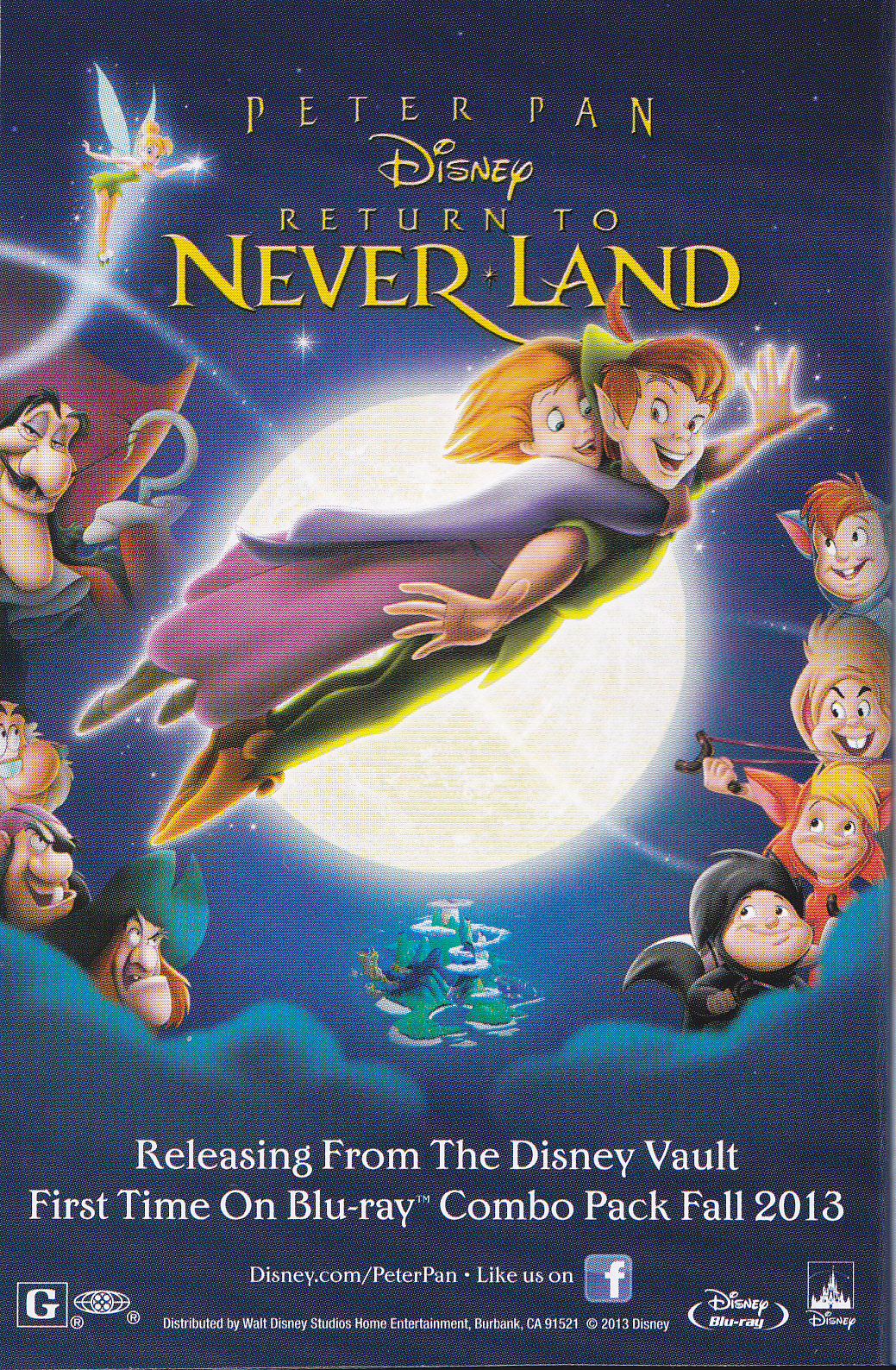
Return to Neverland News

An upcoming release revealed (appropriately) in the packaging for Peter Pan Diamond Edition:


Monday, November 19, 2012

Upcoming Fantasy Films

The blog is in need of much updating (especially a post on NEPCA last month), but, in the meantime, I've been intrigued by some of the latest trailers featuring innovative takes on fictional and legendary heroes:


Sunday, September 16, 2012

Mythcon Updates

The 2012 Mythcon was held last month in Berkeley, California. Details and program of events can be accessed at http://www.mythsoc.org/mythcon/43/.

The call for papers for the 2013 Mythcon has recently been posted. Details as follows:

Mythcon 44 (July 2013)


Green and Growing: The Land and its Inhabitants in Fantasy Literature

Call for Papers: Mythopoeic Society Conference 44
Kellogg Conference Center, Michigan State University
East Lansing, MI – July 12-15, 2013
http://www.mythsoc.org/mythcon/44/

Download the Call for Papers (PDF)


Author Guest of Honor: Franny Billingsley
Franny Billingsley is the author of children’s and young adult fantasy novels The Folk Keeper (winner of the 2000 Mythopoeic Fantasy Award for Children’s Literature), Well Wished, and Chime.

Scholar Guest of Honor: Christopher Mitchell, Ph.D.
Christopher Mitchell is the Director of the Marion E. Wade Center at Wheaton College, Illinois, a major research collection of materials by and about seven British authors: Owen Barfield, G. K. Chesterton, C. S. Lewis, George MacDonald, Dorothy L. Sayers, J. R. R. Tolkien, and Charles Williams.

How does mythopoeic literature address the relationship between the land and its inhabitants, between the wild and the cultivated? What are their respective moral values, their dangers and delights? Tangled forests, majestic trees, ordered fields, carefully tended gardens; or untamed, wild beauty: each offers a different kind of bounty to those who would live off the land. What role do advocates and protectors of the land play in fantasy literature, particularly as personified in characters such as Yavanna, Radagast, Sam Gamgee and, of course, Tom Bombadil.

Our theme also voices many a cautionary tale– Tolkien’s Dead Marshes, the scouring of the Shire, the desolations of Smaug, Saruman and Sauron, the unnatural winter in Narnia– inviting eco-critical approaches to mythopoeic literature. From the whimsical wild places of Baum, Seuss  and Sendak; to the mysterious and often tutelary landscapes of Orwell, Garner and Burroughs– not to mention those of our favorite Inklings– we invite papers on any aspect of the green and growing land in mythopoeic writing.

Papers and panels dealing with the conference themes (or other themes sparked in your brain by this topic) are encouraged. As always, we especially welcome proposals for papers and panels focusing on the work and interests of the Inklings (especially J. R. R. Tolkien, C. S. Lewis, and Charles Williams), of our Guests of Honor, and of other fantasy authors and themes. Papers and panels from a variety of critical perspectives and disciplines are welcome.

Individual papers will be scheduled for one hour to allow time for questions, but should be timed for oral presentation in 40 minutes maximum. Two presenters who wish to present shorter, related papers may also share a one-hour slot, in which case please indicate this on your proposal. Panels will be scheduled for 1.5-hour time slots and normally will include 3-5 presenters who will speak briefly on the subject (usually 10 minutes or less), leaving substantial time for discussion with the audience.

Paper and panel proposals (250 word maximum), along with contact information, should be sent to the appropriate Papers or Panels Coordinator at the following email addresses by 30 April 2013. AV and technology requests must be included in your proposal.

Papers Coordinator
Dr. Leslie A. Donovan
Associate Professor, University of New Mexico
ldonovan@unm.edu

Panels Coordinator
Dr. Judith J. Kollman
Professor Emerita, University of Michigan- Flint
jkollman@umflint.edu

Participants are encouraged to submit papers chosen for presentation at the conference to Mythlore, the refereed journal of the Mythopoeic Society (http://www.mythsoc.org/mythlore). All papers should conform to the MLA Style Manual. Graduate and undergraduate students are especially encouraged to submit proposals and to apply for the Alexei Kondratiev Award for Best Student Paper (see http://www.mythsoc.org/awards/student-paper). For deadlines and applications for this award, contact the Papers Coordinator. Scholars needing financial assistance to attend Mythcon may apply for the Mythopoeic Society’s Glen GoodKnight Memorial Scholarships (formerly called the Starving Scholars Fund). Scholars may request the application form for these awards from the Papers Coordinator.

The Mythopoeic Society is an international literary and educational organization devoted to the study, discussion, and enjoyment of the works of J. R. R. Tolkien, C. S. Lewis, Charles Williams, and mythopoeic literature. We believe the study of these writers can lead to greater understanding and appreciation of the literary, philosophical, and spiritual traditions which underlie their works, and can engender an interest in the study of myth, legend, and the genre of fantasy. Find out about past conferences at http://www.mythsoc.org/mythcon.

Film and History 2012 Conference

The 2012 Film and History Conference meets later this month from 26-30 September 2012 at the Hyatt Regency Downtown in Milwaukee, Wisconsin. There are a number of papers and emtire sessions devoted to the fantastic. The complete program can be accessed at http://www.filmandhistory.org/conference/conference2012.php.

Monday, September 10, 2012

PCA Science Fiction and Fantasy Area CFP


Science Fiction and Fantasy Area of PCA 27-30 March 2013
full name / name of organization:
Popular Culture Association
contact email:
pcasff@gmail.com

One of the largest and most vibrant of the association, the Science Fiction and Fantasy (SF/F) Area invites proposals for its 2013 national conference. The goals of our area are (1) to share and support research, scholarship, and publication and (2) to mentor emerging scholars. As a result, we invite proposals from professors, independent scholars, graduate students, and undergraduates (with the guidance of a professor).

PCA/ACA SF/F welcomes any theoretical or (inter)disciplinary approach to any topic related to SF/F: art; literature; radio; film; television; comics and graphic novels; video, role-playing, and multi-player online games. Though not at all an exhaustive list, potential presenters may wish to consider the following topics. We would particularly like to encourage submissions for 2013 that celebrate a momentous event in the history of SFF. Next year marks the 50th anniversary of Doctor Who. We welcome proposals that examine and celebrate this remarkable achievement. Next year also marks the 5th anniversary of the end of Buffy the Vampire Slayer, a series that changed the face of television.

General Topics
• Fans and Fandom/Community Building
• Gender and Sexuality
• Class and Hierarchies
• Hybridity and Liminality
• Utopia/Dystopia
• Audience Reception
• Translation Issues
• Cross-Media Texts
• Regeneration—Moving Narratives from One Medium to Another
• Language and Rhetoric
• Genre—Space Opera, Cyberpunk, Dark Fantasy, etc.
• Franchising Narratives
• Intertexuality
• Marketing and Advertising
• Textual Analysis
• Sociological or Psychological Readings
• Archival Research
• Technology—Textual and Literal
• Pedagogy—Teaching Science Fiction and Fantasy
• Online Identity Construction
• Use of Music and Silence
• Visual, Spatial, and Design Elements
• Mythology and Quest Narratives
• Steampunk

Examples of Fantasy Texts
• Classic and Contemporary Literature—Gilgamesh; Homer’s Odyssey; J.R.R. Tolkien’s The Lord of the Rings; C.S. Lewis’s Chronicles of Narnia; Terry Pratchett’s Discworld novels; J.K. Rowling’s Harry Potter series; Phillip Pullman’s His Dark Materials collection; Frank Baum’s Oz series; Lewis Carroll’s Alice in Wonderland, Through the Looking Glass and Alice’s Adventures in Wonderland; and works by such authors as Piers Anthony, Marian Zimmer Bradley, Neil Gaiman, Douglas Adams, Orson Scott Card, Margaret Weis, Ursula K. LeGuin, Mercedes Lackey, Patricia McKillip, and others.
• Film—The Princess Bride (1987), Willow (1988), Labyrinth (1986), The Dark Crystal (1982), The NeverEnding Story (1984), The Clash of the Titans (1981; 2009), Ladyhawke (1985), Spirited Away (2001), Donnie Darko (2001), Chocolat (2000), Amelie (2001), Pan’s Labyrinth (2006), etc.
• Television—The Twilight Zone (1959-64), The Prisoner (1967-68), Dark Shadows (1966-71), Wonder Woman (1975-79), Beauty and the Beast (1987-90), Wonderfalls (2004), The Dresden Files (2007), Supernatural (2005-), Xena: Warrior Princess (1995-2001), Charmed (1998-2006), Angel (1999-2004), Buffy the Vampire Slayer (1997-2003), Lost (2004-), Being Human (2009-), Grimm (2011-) and others.
• Comics and Graphic Novels—Buffy the Vampire Slayer, Season 9; Japanese manga; European comics; underground comics movement, etc.
• Gaming—Tomb Raider, World of Warcraft, Dungeons & Dragons, Everquest, Myst, Vampire: The Masquerade, etc.

Examples of Science Fiction Texts
• Classic and Contemporary Literature—from the works of Jules Verne, H.G. Wells, and Mary Shelley to Isaac Asimov, Robert Heinlein, Phillip K. Dick, Kurt Vonnegut, Octavia E. Butler, Anne McCaffrey, Marge Piercy, James Tiptree Jr., Frank Herbert, and Candas Jane Dorsey.
• Film—from Le Voyage Dans La Lune (1902), Frankenstein (1931), and Invasion of the Body Snatchers (1956) to 2001: A Space Odyssey (1968), Star Wars (1977), Alien (1979), Blade Runner (1982), 12 Monkeys (1995), The Matrix (1999), Children of Men (2006), Iron Man (2008), The X-Files: I Want to Believe (2008), Transformers 2 (2009), Star Trek (2009).
• Television—classic TV such as Star Trek: The Original Series (1966-1969) and The Twilight Zone (1959-1964) to recent series of interest, including Lexx (1997-2002), Twin Peaks (1990-91), The X-Files (1993-2002), Dark Angel (2000-02), The 4400 (2004-07), the Stargate series including Universe, Babylon 5 (1993-98), Battlestar Galactica (2004- 2008), Terminator: the Sarah Connor Chronicles (2007 - 2009), Torchwood (2006-), Primeval (2007-), Heroes (2007-), Firefly (2002-03), Sanctuary (2008-12), Eureka (2006-12), and others.

The SF/F Area is also interested in featuring science fiction and fantasy writers and poets. Creative writers are welcomed.

Submission Guidelines: In Word (.doc/.docx), Rich Text Format (.rtf), or PDF, completed papers or 250-word proposals for individual papers, panels, roundtables, workshops, or creative writing readings should be submitted through the PCA website. Instructions for submission can be found at www.pcaaca.org/conference/instructions.php and submissions made at http://ncp.pcaaca.org . The document should contain the following information in this order:

• Name(s) of presenter(s)—indicate main contact person if submitting a group presentation
• Institutional affiliation—if applicable
• Name and contact information of cooperating professor—undergraduates only
• Address(es), telephone number(s), and email address(es) of presenter(s)
• Title(s) of paper(s), panel, roundtable, or workshop
• Completed paper(s) or 250-word proposal(s)—if submitting a workshop, please specifically indicate what those in attendance will gain
The paper/panel proposal will be acknowledged when received, and the sender will be notified of the submission’s status no later than 1 January 2013.

Please be aware that the Area Chairs are not able to submit proposals on your behalf. If there is a problem while submitting papers please contact the Chair.

Please, do not simultaneously submit the same proposal to multiple areas. Doing so is a discourtesy to area chairs. Also please note that, per PCA/ACA guidelines, a person may present only one paper at the annual meeting, regardless of subject area. This includes roundtables, that is, a person cannot present a paper and a roundtable discussion.

Submission Deadline: 29 November 2012

Each year after the last conference panel on Saturday evening, the SF/F Area hosts a fundraising event that includes a film, snacks, and a prize raffle of DVDs, novels, academic books, etc.—thousands of dollars in merchandise. Come enjoy the food, friendship, and fun! Location TBA; film TBA. Fundraising supports area activities and, beginning with the 2011 conference, awards to the two best papers, graduate student and professional. More details about these awards can be found at the area’s website: www.pcasff.org

Please be aware that the PCA offers several travel bursaries and deadlines for them are the 7 January 2013. Check the PCA website www.pcaaca.org for more information.

Hope to see you in DC!

Your Area Co-Chairs:

Dr. Gillian I Leitch
23 Blvd Mont-Bleu, #1
Gatineau, QC
Canada J8Z 1H9

and

Dr. Sherry Ginn
Rowan-Cabarrus Community College
1531 Trinity Church Rd
Concord, NC 28110 USA

Direct all enquiries to our email address: pcasff@gmail.com

NOTE: While the PCA/ACA welcomes fresh approaches to subjects, we also appreciate serious commitment to scholarship and to presenting at the conference.